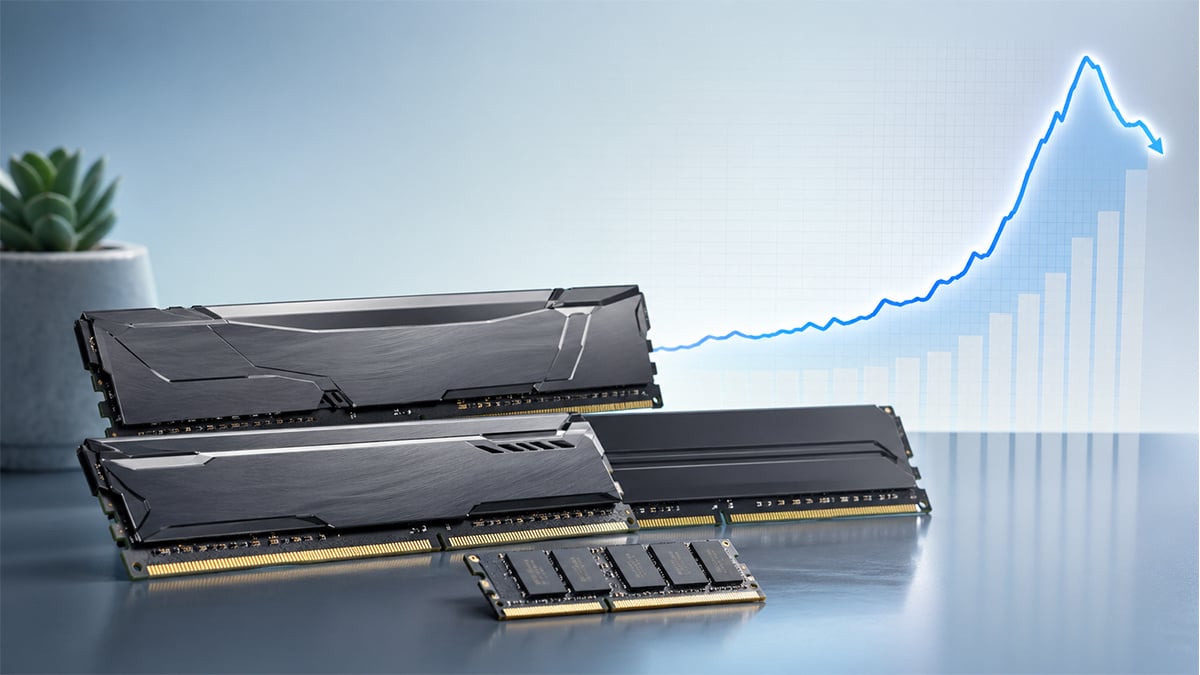
RAM prices are finally giving buyers a little breathing room, but breathing room is not the same as relief. After a brutal 2025, when DDR4, DDR5, LPDDR5, and server memory all became more expensive as AI demand pulled supply away from consumer hardware, some retail RAM prices have started to flatten or even dip in select markets. That sounds like good news for PC builders, laptop shoppers, and gamers, but the larger memory market has not returned to normal. DRAM contract prices are still projected to rise sharply in Q2 2026, suppliers are still prioritizing AI and server demand, and analysts warn that the recent retail drop may be a short-term correction rather than the end of the RAM crisis.
Why the RAM crisis happened
The RAM crisis started because memory demand changed faster than memory supply could respond. For years, consumer RAM was treated as a predictable PC component. Then AI data centers began competing for the same broader memory supply chain, especially high-bandwidth memory, or HBM, which is used in advanced AI accelerators. As suppliers shifted more wafer capacity, packaging resources, and long-term contracts toward server and AI customers, less capacity was left for ordinary DDR4, DDR5, LPDDR5, SSDs, and other consumer-facing memory products. That is why the price shock has not been limited to DIY RAM kits. It has also affected laptops, desktops, phones, game consoles, and storage devices.
The problem is not simply that manufacturers can “make more RAM.” Memory production depends on expensive fabs, limited 300 mm wafer supply, advanced packaging capacity, and long planning cycles. New plants can take years to build and ramp to volume production, which means suppliers cannot quickly flood the market with more DRAM just because prices are high. SK Hynix, for example, has invested heavily in advanced packaging for AI memory, but that still reflects the same reality: the fastest-growing demand is coming from AI infrastructure, not consumer PC upgrades.
There is also a product mix issue. DDR4 was already being phased down as the industry moved toward DDR5, while HBM and server memory became more attractive to manufacturers because data center customers are willing to pay more and sign larger long-term contracts. At the same time, modern devices are using more memory than before. Many laptops now ship with 16 GB or 32 GB, games and creative workloads are more demanding, and AI features are increasing memory requirements across PCs and mobile devices.
That is why the RAM crisis became so severe. It is not one shortage in one category. It is a supply chain being pulled toward higher-margin AI, server, and enterprise customers while consumer demand remains high. Even with new investment, the market remains tight, and consumers are still competing against buyers with deeper pockets and larger long-term contracts.
Are RAM prices finally starting to go down?
Some RAM prices have started to come down, but buyers should be careful about what that really means. The recent price drop is real in certain retail markets, but it needs context. German consumer RAM prices reportedly fell 7.2% month over month, while Chinese retail pricing was down 20%. One U.S. example also showed a 32 GB Corsair Vengeance DDR5 kit falling from $490 to $380, a drop of about 22%. That sounds encouraging, especially after months of brutal price hikes.
But these discounts are coming from extremely elevated prices, not from normal market conditions. Earlier in the crisis, some DDR5 modules had already climbed 120% to 200%, while broader DRAM pricing indexes were up nearly 50%. In other words, a 7%, 20%, or even 22% drop does not erase the larger surge that came before it. RAM may be cheaper than it was a few weeks ago, but it is still far more expensive than it was before the crisis.
The more likely explanation is that retailers and resellers pushed prices too high, then had to pull back when consumers slowed their purchases. The market may be correcting the most aggressive retail pricing, not fixing the underlying shortage. Some of the recent softness may come from localized inventory pressure, weaker consumer demand, or stores trying to move stock before the next round of supply-chain increases reaches retail shelves.
That distinction matters. A true recovery would mean that the supply side has meaningfully improved. That has not happened yet. The same supply pressures are still in place, even if some retail prices have softened. AI and server customers continue to command much of the industry’s attention, and consumer RAM remains exposed to the same tight market that caused prices to surge in the first place.
So will this downward trend continue? Probably not in a meaningful way. Short-term discounts may continue to appear, especially on specific RAM kits or during retail promotions, but the broader trend still points toward elevated pricing. More importantly, the contract market still points upward, with TrendForce expecting conventional DRAM prices to rise another 58% to 63% in Q2 2026. That suggests the recent dip may be more of a temporary pause than the start of a full price recovery.
For consumers, that means RAM may feel slightly less painful to buy than it did a few months ago, but the market is still far from cheap. The current drop is better understood as a correction after an extreme spike, not a sign that the RAM crisis is over.
Will RAM prices go up again later?

The recent drop may not last. If today’s lower retail prices are mostly a short-term correction, RAM could become more expensive again as higher supply-chain costs move through the market.
That is the key point for consumers: retail prices and contract prices do not always move at the same time. A store may lower prices to clear inventory or attract buyers after demand slows, even while manufacturers and large buyers are still negotiating higher prices behind the scenes. If those higher costs reach retailers later, today’s discounts could disappear quickly.
Efficiency gains in AI may not solve the problem either. Google’s TurboQuant technology reportedly claims up to 6x lower memory usage for AI models, which sounds like it should reduce pressure on the memory market. But if AI companies are still compute- and memory-constrained, using memory more efficiently may simply let them run more models, process more requests, or expand workloads instead of releasing supply back to consumers.
That is why the recent price dip should not be treated as a return to the old pricing environment. It may help buyers who already planned to upgrade, but it does not prove that the shortage is over. Unless supply expands faster than expected or AI demand cools sharply, RAM prices are likely to remain expensive, uneven, and vulnerable to another round of increases.
What should consumers do now?
For most consumers, the smartest move is to buy based on need, not panic. If your current laptop or desktop still handles your daily work, school, gaming, or creative tasks comfortably, there is no need to rush into an upgrade just because RAM prices may rise again. Paying more for memory you do not need yet is still paying more.
But if your system is already struggling, waiting for a full return to old RAM prices may not be realistic. The market has softened in some places, but the larger supply chain remains under pressure. If you need more memory for gaming, video editing, AI tools, schoolwork, remote work, or general multitasking, this may be a reasonable time to compare prices and buy when you see a configuration that fits your budget.
One practical option is to look at complete systems instead of upgrading piece by piece. Pre-configured laptops and desktops can sometimes offer better value because the memory, processor, graphics, display, and storage are already balanced for the intended use. That can be especially helpful in a market where individual RAM kits may swing sharply in price.
For everyday users, students, professionals, and remote workers, the Acer Swift lineup is worth considering. Swift laptops are built around portability, productivity, and efficient performance, making them a strong fit for users who want a thin and light laptop that can handle modern multitasking without feeling bulky. Choosing a system with enough memory from the start can also reduce the need for expensive upgrades later.
For gamers and creators, the Acer Nitro lineup is a strong fit for users who want solid performance without overspending. Nitro laptops and desktops are built to deliver a good balance of graphics power, fast displays, memory, and storage at a more accessible price point than premium gaming systems. That makes them especially practical for modern games, streaming, school projects, entry-level content creation, and everyday multitasking. In a volatile RAM market, buying a complete Nitro system with a balanced CPU, GPU, and memory configuration can be a better bang-for-your-buck option than building or upgrading one component at a time.
The main takeaway is simple: the RAM crisis may be easing at retail, but it is not over. Do not buy out of fear, but do not assume prices will quickly return to where they were before the surge. If your current device still works well, wait and watch for better deals. If you already need an upgrade, focus on total system value, choose enough memory for the next few years, and consider a well-configured Acer Swift or Nitro system before component prices rise again.
Readers who want to better understand RAM, upgrades, and memory management can also check out our related guides. Learn how to clear RAM in Windows 11, follow our step-by-step guide to upgrading your Acer laptop’s RAM, or explore Acer computers with 32 GB or more of RAM if you are considering a system with more memory from the start.
FAQ
Are RAM prices going down?
Some RAM prices have started to fall in certain retail markets, but that does not mean the RAM crisis is over. The recent drop appears to be a short-term correction after months of steep price increases, not a full return to normal pricing.
Why did RAM prices get so expensive?
RAM prices rose because AI data centers began consuming more memory supply, especially high-bandwidth memory used in advanced AI hardware. At the same time, manufacturers shifted more capacity toward server and AI customers, leaving less supply for consumer products like laptops, desktops, gaming PCs, phones, and RAM kits.
Will RAM prices go back to normal soon?
Probably not soon. Memory production takes years to expand, and demand from AI, data centers, and modern consumer devices remains high. Short-term discounts may appear, but a broad return to pre-crisis RAM prices is unlikely in the near future.
Could RAM prices go up again?
Yes. The recent retail drop may not last if higher contract prices and supply-chain costs move through the market. If retailers are only lowering prices to clear inventory or attract buyers, prices could rise again once new costs reach store shelves.
Should I buy RAM now or wait?
Buy based on need, not panic. If your current device still performs well, it may be worth waiting for deals. But if your laptop or desktop is already struggling with gaming, multitasking, creative work, or AI tools, waiting for much lower RAM prices may not be realistic.
Is it better to buy a complete system instead of upgrading RAM separately?
In some cases, yes. A pre-configured laptop or desktop can offer better overall value because the memory, processor, graphics, storage, and display are already balanced. This can be especially useful when individual RAM kits are expensive or unpredictable.
How much RAM do most people need?
For everyday browsing, schoolwork, streaming, and office tasks, 16 GB is a strong baseline. For gaming, content creation, heavier multitasking, and AI-assisted workflows, 32 GB is becoming a more practical choice. Users working with large creative files, virtual machines, or advanced professional workloads may need even more.
Recommended Products