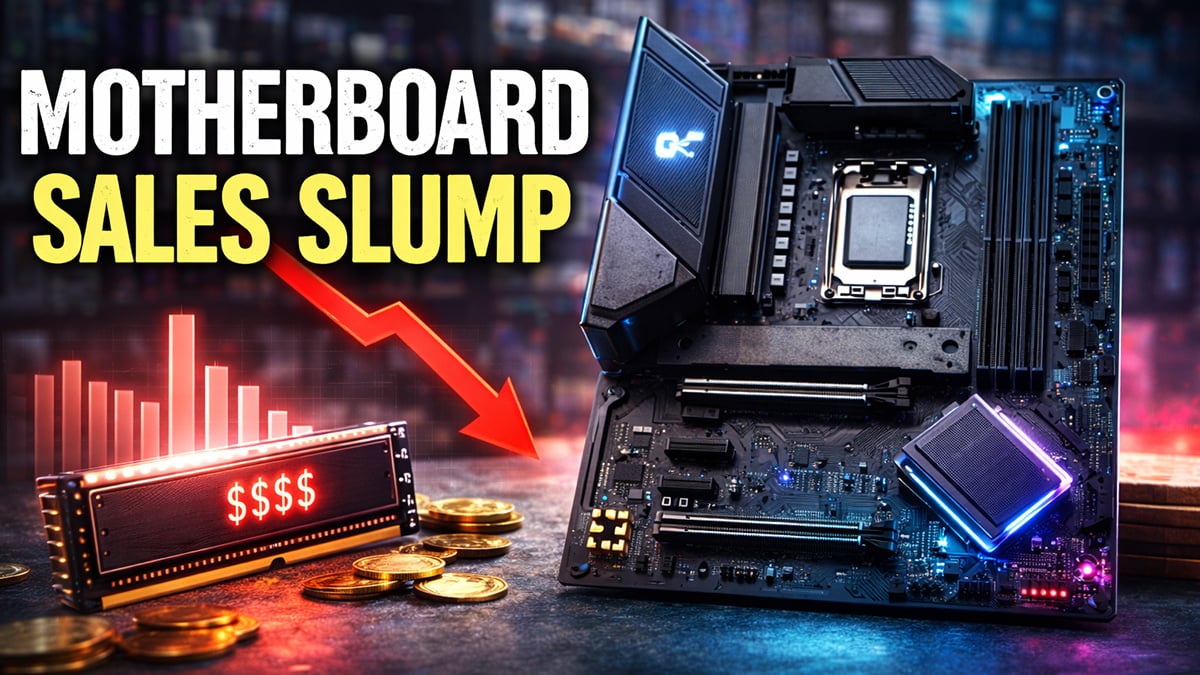
The impact of rising memory prices is spreading well beyond RAM kits themselves. What began as a sharp increase in DRAM costs is now translating into a measurable slowdown across the broader PC hardware market, with motherboard sales reportedly falling at a pace that has prompted manufacturers to reassess product launches and sales targets.
Major motherboard vendors have seen motherboard sales decline by approximately 40 to 50 percent compared with the same period in 2024. The drop reportedly covers the November–December 2025 window, a time that typically benefits from Black Friday promotions and year-end consumer upgrades.
Why motherboard demand is collapsing
The underlying issue is not motherboard pricing itself. The problem lies in the cost of building a complete modern platform. Current mainstream desktop platforms now require DDR5 memory outright, which removes the budget flexibility that previously existed with DDR4 systems. As DRAM prices began climbing in October 2025, the total cost of entry for a new build rose sharply, discouraging many consumers from committing to full system upgrades.
DRAM supply has increasingly been prioritized for enterprise, data center, and AI focused workloads, where higher margins justify allocation. That shift has reduced availability at the consumer level and pushed prices higher across the board. For many enthusiasts, the added cost of memory alone is enough to delay or cancel an upgrade. Motherboards, being part of a bundled purchasing decision, are among the first components to feel the slowdown.
Sales targets cut and product launches delayed
The scale of the slowdown is forcing motherboard manufacturers to reassess near-term expectations. With fewer consumers committing to full platform upgrades, vendors are increasingly cautious about production volumes, inventory planning, and the timing of new releases.
In a softer demand environment, launching refreshed or higher-end models carries greater risk. Excess inventory becomes harder to clear, pricing pressure increases, and promotional activity may fail to generate the usual lift. As a result, manufacturers are more likely to space out releases, prioritize existing product lines, or delay introductions until market conditions improve.
This more conservative approach reflects an effort to balance supply with reduced demand rather than push new hardware into a market that is not ready to absorb it. For consumers, it may mean fewer high-profile launches in the short term, but a more stable lineup once pricing pressures across memory and other components begin to ease.
CPU platforms are not immune
The slowdown in motherboard sales is also expected to ripple into CPU demand. Desktop processors are rarely purchased in isolation, and fewer platform upgrades naturally translate into fewer CPU sales.
AMD may be somewhat insulated in the short term thanks to backward compatibility across parts of its ecosystem, including continued support for existing AM5 boards and its Ryzen 9000 series. Even so, there is little incentive for many users to move from Ryzen 7000 to 9000 if it involves paying significantly more for DDR5 memory.
Intel faces similar challenges. Users on older DDR4 systems cannot transition to newer LGA1851 motherboards and Core Ultra 200S processors without absorbing the cost of DDR5, further dampening interest. This environment is unlikely to help momentum for Intel’s upcoming Arrow Lake Refresh, which will arrive into a market already cautious about platform spending.
Broader consequences for the PC market
Memory pricing pressures are also intersecting with rising NAND flash costs, particularly for TLC and QLC wafers commonly used in consumer SSDs. GPU pricing has offered little relief either, with recent sales events failing to deliver meaningful reductions. Taken together, these factors make PC building increasingly expensive at a time when consumer budgets are already strained.
The result is a slowdown that extends beyond individual components. Fewer new builds affect motherboard makers, CPU vendors, memory suppliers, and even system integrators. Over time, this environment could also reduce the availability of lower-cost gaming PCs, further narrowing the entry point for new users.
A pause, not a permanent shift
While the current situation is disruptive, it is unlikely to be permanent. DRAM pricing cycles have historically corrected through increased production, demand normalization, or shifts in broader technology investment trends. Whether relief comes from expanded manufacturing capacity, cooling AI-driven demand, or other market adjustments remains uncertain.
For now, however, the message from the market is clear. Rising DRAM prices are not just inflating memory costs; they are reshaping consumer behavior across the entire desktop PC ecosystem. Until those prices stabilize, motherboard sales declines may be less an anomaly and more a reflection of a PC upgrade cycle on pause.
Frequently Asked Questions
Why are motherboard sales dropping right now?
Motherboard sales are declining primarily because the cost of building a full PC has increased. Modern platforms require DDR5 memory, and rising DRAM prices have made upgrades significantly more expensive. As a result, many consumers are delaying or cancelling full system builds, which directly impacts motherboard demand.
Are high DRAM prices the only reason for weaker PC sales?
No. While DRAM prices are a major factor, they are part of a broader cost increase across PC components. SSD prices have risen due to NAND shortages, and GPU pricing has remained elevated. Together, these pressures increase the total cost of a PC, discouraging new purchases.
Does this affect both AMD and Intel platforms?
Yes. Both ecosystems are impacted because new platforms require DDR5 memory. AMD users upgrading to newer AM5 systems must factor in higher memory costs, while Intel users moving from older DDR4 platforms face the same issue. The memory requirement is now unavoidable for current-generation desktops.
Is it still worth upgrading a PC in 2026?
It depends on your current system and needs. If your PC already meets your performance requirements, waiting may be the more cost-effective option until memory pricing stabilizes. Incremental upgrades such as storage, cooling, or peripherals can often extend the useful life of an existing system without the expense of a full rebuild.
Will motherboard and memory prices come down again?
Historically, memory pricing has moved in cycles. Increased production, reduced enterprise demand, or shifts in broader market conditions could eventually ease prices. While there is no guaranteed timeline, current conditions are widely viewed as temporary rather than permanent.
How does this impact prebuilt gaming PCs?
System integrators are also affected by higher component costs, which can lead to price increases or fewer budget-focused configurations. Entry-level and mid-range gaming PCs may become harder to find at previous price points until memory and storage costs normalize.
What should PC enthusiasts do in the meantime?
For now, many enthusiasts are choosing to wait. Others are investing in quality-of-life upgrades such as monitors, input devices, or storage rather than committing to a full platform change. These smaller upgrades can still deliver noticeable improvements without the high upfront cost of a new build.
Recommended Products