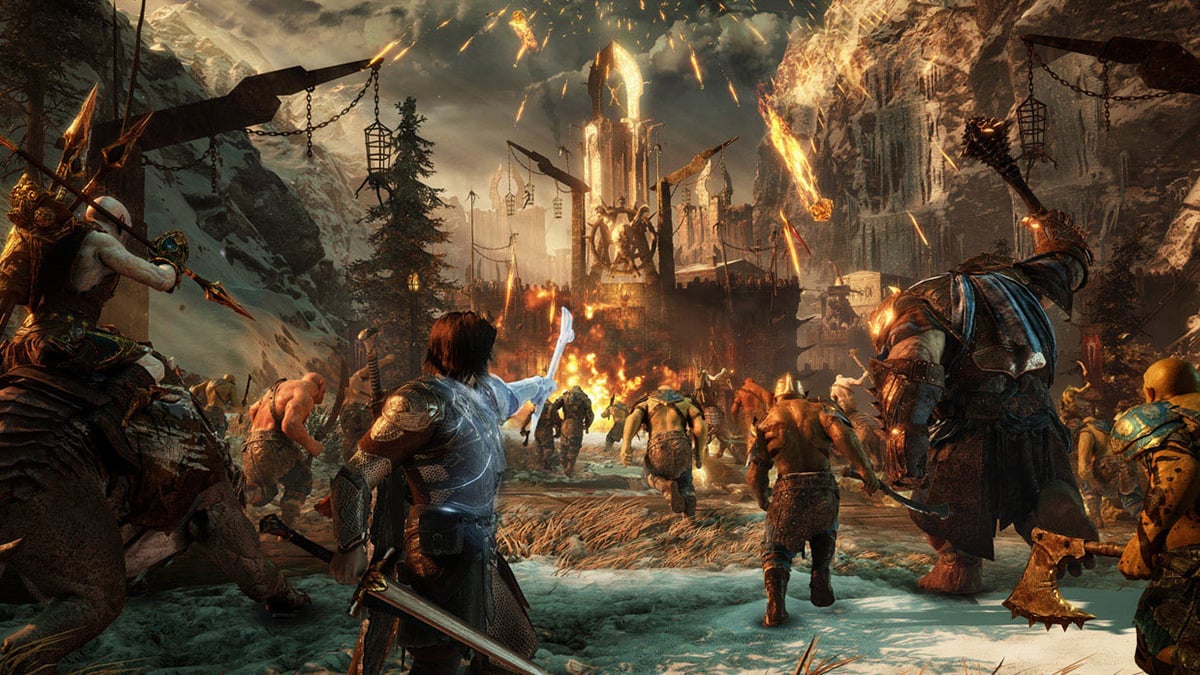
First introduced in Middle-earth: Shadow of Mordor in 2014, the Nemesis System is one of the most ambitious gameplay innovations of the past decade. Developed by Monolith Productions, it transforms ordinary enemy encounters into evolving rivalries by giving enemies persistent identities, memories, and the ability to change based on how players interact with them. Orc captains remember past defeats, taunt you over previous humiliations, rise through ranks when they kill you, and sometimes even return from death bearing scars and grudges. What begins as a procedural villain generator quickly becomes a deeply personal, player-driven story engine, one that reached its full potential in Middle-earth: Shadow of War and left a lasting impression on players who experienced it.
How the Nemesis System Works
At its core, the Nemesis System functions as a dynamic storytelling engine that reacts to player behavior rather than following a fixed script. Instead of enemies existing as disposable NPCs, the system tracks encounters, outcomes, and patterns of interaction, then uses that data to shape future events.
Every notable enemy is procedurally generated with a name, appearance, voice, combat traits, strengths, weaknesses, and a distinct personality. More importantly, they remember you. If an enemy defeats you, escapes, is humiliated, or cheats death, that outcome is logged by the system and referenced in future encounters through dialogue, behavior changes, and even visual alterations such as scars, prosthetics, or altered armor.

The system also relies heavily on non-lethal outcomes to sustain long-term narratives. Enemies may flee, mock you instead of killing you, survive fatal blows, or ambush you later when you least expect it. Likewise, the player’s own deaths are treated as canonical events rather than failures, allowing rivals to grow stronger, gain promotions, and develop reputations based on how they defeated you.
All of this operates within a living hierarchy. Enemies exist in a structured chain of command, where captains can rise to power by killing the player or defeating rivals, and powerful leaders can fall through humiliation or betrayal. These power shifts often occur independently of the player through background missions, ensuring the world continues to evolve even when you are not directly involved.
What makes the Nemesis System especially effective is that it combines procedural generation with handcrafted content. While encounters are systemic and unpredictable, they are anchored by curated dialogue, animations, and personality archetypes that make individual rivals feel memorable. The result is a system that creates stories in real time, assembling them from player actions, enemy reactions, and emergent relationships rather than pre-written narrative beats.
Why Gamers Loved the Nemesis System
The Nemesis System resonated with players because it made their experiences feel genuinely personal in a way few single-player games ever had. Instead of delivering the same scripted moments to every player, it allowed unique stories to emerge organically from moment-to-moment gameplay. No two playthroughs were the same, and no two players ended up with the same rivals, allies, or outcomes.
One of its greatest strengths was emotional investment. Enemies were not just obstacles. They were characters with history. When an Orc killed you, mocked your failure, earned a promotion, and later ambushed you again with new scars and taunts, it created a powerful sense of rivalry. Revenge felt earned rather than scripted. Victory carried narrative weight because it resolved a relationship that had been built over hours of play.

Players also appreciated how naturally the system integrated storytelling into core mechanics. You did not have to make dialogue choices or follow branching narrative menus. Simply playing the game, fighting, fleeing, dying, or humiliating enemies, was enough to shape the story. This made the Nemesis System accessible to players who might normally ignore narrative-heavy RPGs, while still offering depth for those who cared about emergent storytelling.
Another reason for its popularity was how it blurred the line between single-player and multiplayer experiences. The system replicated the feeling of rivalry normally found in competitive games, where recurring opponents develop reputations and grudges over time. According to Monolith Productions, this sense of multiplayer-style relatedness was a core design goal, and it is something players consistently praised as fresh and memorable.
Ultimately, gamers loved the Nemesis System because it respected player agency. It did not tell players what their story was. It observed what they did and built meaning around those actions. That combination of systemic design, emotional payoff, and player-driven narrative is why the system is still discussed more than a decade later, despite appearing in only a handful of games.
Why the Nemesis System Is in Patent Hell, and How U.S. Gameplay Patents Work
The biggest reason the Nemesis System has not appeared widely across the industry is not technical complexity. It is legal ownership. Monolith Productions, under its parent company Warner Bros. Games, was granted a U.S. patent covering the core mechanics behind the Nemesis System. That patent does not protect a specific character or story. It protects a method of gameplay, specifically the idea of procedurally generated enemies who remember past encounters, evolve based on player interaction, and form persistent relationships within a hierarchy.
In the United States, game mechanics can be patented if they meet three criteria: they must be novel, non-obvious, and useful. Unlike copyright, which protects expression, patents protect systems and processes. Once approved by the United States Patent and Trademark Office, the patent holder gains exclusive rights to that system for a fixed period, generally twenty years from filing.
This creates a chilling effect across the industry. Even if another studio builds a system that feels meaningfully different in tone or presentation, the risk of infringement remains if the underlying mechanics resemble the patented claims. For most developers, especially indie and mid-sized studios, the cost of defending a lawsuit is enough to stop experimentation before it begins. As a result, many teams avoid deep emergent enemy systems altogether rather than risk legal exposure.
Warner Bros. has technically been free to reuse the Nemesis System internally, but it has done so sparingly. Planned projects that were rumored to incorporate it never materialized in a visible way, and the system remained closely associated with the Middle-earth games rather than becoming a studio-wide pillar.
More recently, industry discussion has intensified due to reports that control of the Nemesis System patent now sits under Netflix’s games division following corporate asset transfers involving Warner-related properties. While the exact corporate structure is still being clarified publicly, what matters to developers is simple: the system remains locked behind exclusive ownership, with no clear, standardized licensing pathway available to outside studios.
This is why the Nemesis System is often described as being in “patent hell.” It is widely admired, broadly requested, and technically feasible to adapt, yet functionally unreachable for most of the industry due to legal risk rather than creative limitation.
If you are ready, the next section can cover whether the system could realistically be freed, including the current petition and what a developer-friendly licensing model could look like in practice.
Could the Nemesis System Be Freed Soon?
For the first time in years, there is a realistic conversation about the Nemesis System becoming accessible to the wider industry. This shift is driven by reports that control of the Nemesis System patent now sits with Netflix, following its future acquisition of Warner-related assets and expansion into game publishing.
This change in ownership matters because Netflix is not a traditional games publisher with a single franchise to protect. Its games strategy is still evolving, and its long-term value comes from growing an ecosystem rather than guarding one specific implementation. That creates an opportunity for a different approach to the patent.
Developers are not asking for the Nemesis System to be open sourced or stripped of protection. Instead, the current push focuses on something far more practical: a clear, affordable, and transparent licensing program. Under this model, Netflix would retain ownership of the patent while allowing studios of all sizes to legally build Nemesis-inspired systems without fear of litigation.
A community-led petition is already calling for exactly this kind of solution. The proposal argues that a standardized licensing framework would benefit everyone involved. Developers could finally experiment with emergent rival systems in genres like RPGs, strategy games, immersive sims, survival titles, and roguelikes. Netflix would gain licensing revenue, goodwill within the developer community, and long-term influence over how one of gaming’s most celebrated systems evolves.
Importantly, this petition does not demand immediate action or retroactive permission. It asks for dialogue, visibility, and a pathway forward. In an industry where innovation often stalls due to legal uncertainty, even a modest licensing program would represent a major step.
Whether the Nemesis System is freed depends entirely on Netflix’s willingness to treat the patent as a platform rather than a locked vault. If it chooses engagement over restriction, the system could finally move beyond a single franchise and become a foundational design tool for the next generation of games.
Next, we can close by looking at the long-term future of the Nemesis System and what kinds of games could benefit most if it is finally allowed to evolve beyond Middle-earth.
Final Thoughts
The Nemesis System remains one of the clearest examples of how systemic design can create stories that feel personal, reactive, and genuinely memorable. First introduced in Middle-earth: Shadow of Mordor, and refined in Middle-earth: Shadow of War, it showed that enemies do not need scripted arcs to become compelling characters. They only need memory, consequence, and the ability to change.
Its absence from the wider industry has never been about lack of interest. Developers have been vocal for years about wanting similar systems, and players continue to cite the Nemesis System as one of the most distinctive mechanics of the last generation. The barrier has always been legal uncertainty, not creative hesitation.
With the patent now reportedly under the control of Netflix, there is a rare chance to reset that trajectory. A fair, transparent licensing model would not diminish the value of the patent. It would amplify it. It would allow one of gaming’s most celebrated ideas to evolve across genres, studios, and creative visions, rather than remain frozen in a single franchise.
Whether that happens is still an open question. But the renewed discussion, the active petition, and the continued admiration for the system all point to the same conclusion. The Nemesis System deserves more than to be remembered as a great idea locked away by circumstance. If given room to grow, it could still shape the future of how games tell stories, not through scripts, but through play itself.
Recommended Products

Acer Nitro 60 (RTX 5070)
Buy Now |

Predator Helios 18 (RTX 5080)
Buy Now |

Acer Nitro V 15 (RTX 5050)
Buy Now |
|---|