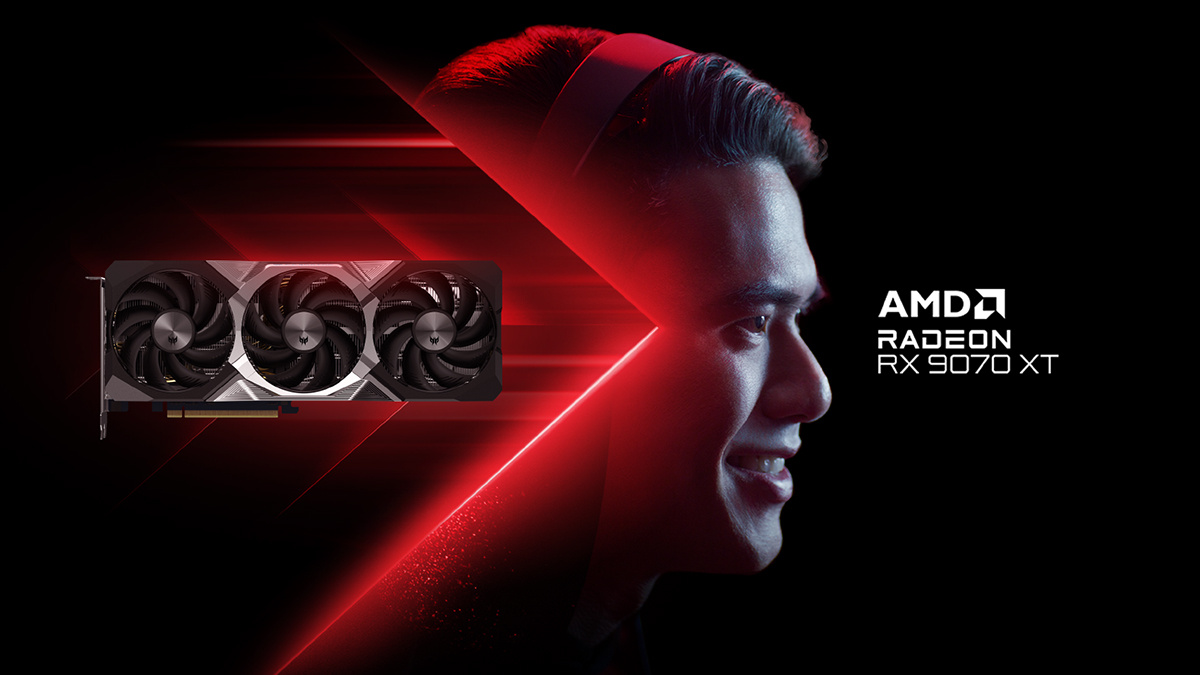
In 2025/2026, the AMD Radeon RX 9070 XT stands out as the best value graphics card by delivering architectural balance, ample VRAM, and sustained real-world performance rather than chasing peak benchmark numbers. Modern PC games are increasingly shader-heavy, memory-intensive, and designed around long play sessions instead of short performance bursts. Built on AMD’s RDNA 4 architecture and manufactured on an advanced 4 nm process, the RX 9070 XT combines a large, efficient compute layout with 16 GB of VRAM, high memory bandwidth, and modern graphics features at a launch price of US$599. On specifications alone, it aligns closely with how games are actually developed and played in 2025, which is why it emerges as the strongest value-focused GPU of the year before performance results are even considered.
Technical specifications breakdown
The AMD Radeon RX 9070 XT is based on AMD’s Navi 48 XTX graphics processor, part of the RDNA 4 (Navi IV) generation. The GPU is manufactured by TSMC using the 4 nm N4P FinFET process, resulting in a 357 mm² monolithic die containing approximately 53.9 billion transistors, with a transistor density of roughly 151 million transistors per square millimeter. This scale places Navi 48 among the most complex consumer GPU dies currently in production, while remaining compact enough to control manufacturing cost and yields.
From a compute standpoint, the RX 9070 XT features 64 compute units (CUs), exposing a total of 4,096 stream processors (shading units). These are complemented by 256 texture mapping units (TMUs) for texture filtering and sampling, and 128 render output units (ROPs) responsible for final pixel output, blending, and framebuffer operations. This relatively strong ROP configuration is especially important for high-resolution rendering, as it reduces pixel throughput bottlenecks at 1440p and 4K. The GPU also integrates 64 third-generation ray tracing acceleration cores and 128 third-generation matrix (AI) cores, enabling hardware-accelerated ray tracing and machine-learning-assisted workloads such as upscaling.
Clock behavior is designed around sustained performance rather than brief boost spikes. The RX 9070 XT operates at a 1,660 MHz base clock, with a typical game clock of 2,400 MHz, and boost frequencies reaching up to 2,970 MHz under favorable thermal and power conditions. At these frequencies, the GPU delivers a theoretical compute throughput of approximately 48.66 TFLOPs of FP32 performance, 97.32 TFLOPs of FP16 performance, and 1.52 TFLOPs of FP64 performance, reflecting its focus on gaming and real-time graphics workloads rather than heavy double-precision compute.
The memory subsystem is a core part of the RX 9070 XT’s value proposition. The card is equipped with 16 GB of GDDR6 memory, operating at 20.1 Gbps effective data rate and connected via a 256-bit memory interface, resulting in a total memory bandwidth of 644.6 GB/s. This is supplemented by AMD’s third-generation Infinity Cache, consisting of 64 MB of L3 cache, alongside 8 MB of L2 cache and 32 KB of L0 cache per workgroup processor. This cache hierarchy reduces reliance on external memory accesses, improves effective bandwidth, and helps stabilize performance in memory-intensive scenarios such as large open-world games and ray-traced workloads.
From an I/O and platform perspective, the RX 9070 XT uses a PCI Express 5.0 x16 interface, ensuring ample bandwidth for current and future platforms. Display output support includes one HDMI 2.1b port and three DisplayPort 2.1a ports, allowing for high-refresh-rate 4K and emerging high-resolution display configurations. Power delivery is handled through two standard 8-pin PCIe power connectors, with a total board power (TDP) of 304 W and a recommended system power supply of 700 W, keeping the card compatible with a wide range of existing enthusiast-grade systems.
Taken together, these specifications illustrate why the RX 9070 XT is architected around real-world gaming demands in 2025: high shader throughput, strong pixel output capability, ample VRAM, and a memory system designed to cope with increasingly complex game assets. This balanced approach at the silicon and platform level underpins the card’s reputation as a value-focused GPU before benchmark results or pricing dynamics are even considered.
Why these Specs translate well for 1440p and 4K Gaming
The specification balance of the AMD Radeon RX 9070 XT aligns closely with the technical realities of modern 1440p and 4K gaming, where performance constraints are increasingly driven by memory throughput, shader load, and pixel output rather than raw clock speed alone. At higher resolutions, the GPU must process significantly more pixels per frame while simultaneously handling larger textures, more complex lighting passes, and heavier post-processing effects. The RX 9070 XT’s combination of 4,096 shaders, 256 TMUs, and 128 ROPs ensures that neither shading nor pixel fill becomes a limiting factor as resolution increases. In particular, the strong ROP configuration plays a critical role at 4K, where pixel output and blending workloads scale linearly with resolution and can bottleneck GPUs that are otherwise compute-capable.
Memory capacity and bandwidth are equally decisive at these resolutions. With 16 GB of GDDR6 and 644.6 GB/s of bandwidth, the RX 9070 XT avoids the memory pressure issues that increasingly affect GPUs with narrower buses or lower VRAM allocations. Modern games frequently exceed 10–12 GB of VRAM usage at 1440p and 4K when high-resolution textures, ray-traced effects, and large open-world assets are enabled. Having 16 GB available reduces asset streaming stalls, minimizes texture pop-in, and allows the GPU to maintain consistent frame pacing during traversal-heavy gameplay. This is further reinforced by the 64 MB third-generation Infinity Cache, which reduces external memory traffic and improves effective bandwidth in scenarios where data reuse is high, such as repeated shader passes and deferred rendering pipelines.
Sustained clock behavior also matters more at higher resolutions than peak boost figures. The RX 9070 XT’s 2.4 GHz game clock is designed to be maintainable under long gaming sessions, ensuring stable performance during extended 1440p and 4K workloads rather than brief benchmark runs. Combined with a 304 W power envelope, this allows the GPU to deliver consistent frame rates without aggressive thermal throttling, which is especially important in graphically demanding titles that maintain high GPU utilization for extended periods.
Taken together, these factors explain why the RX 9070 XT performs so comfortably at 1440p and scales effectively into 4K. Its compute density, pixel throughput, and memory subsystem are not overbuilt in any single area, but instead tuned to the specific bottlenecks that emerge as resolution and asset complexity increase. This balance is precisely what allows the card to deliver smooth, high-quality gaming at these resolutions without relying excessively on aggressive upscaling or reduced visual settings, reinforcing its position as a value-oriented GPU that performs where it matters most in 2025.
Gaming-focused software developments and the RDNA 4 software stack

Beyond raw hardware specifications, the AMD Radeon RX 9070 XT benefits from a series of recent software developments that are explicitly designed around modern game engines and rendering techniques. AMD’s current software strategy focuses on reducing the computational cost of advanced visuals while preserving image quality, rather than relying solely on brute-force performance increases. This approach aligns closely with the RX 9070 XT’s hardware configuration and helps extend its usefulness as games continue to push higher visual complexity in 2025 and beyond.
A major pillar of this strategy is FidelityFX Super Resolution 4 (FSR 4), AMD’s latest generation upscaling technology. FSR 4 shifts emphasis away from purely spatial reconstruction toward machine learning assisted temporal upscaling, improving edge stability, texture clarity, and motion handling compared to earlier versions. While support is still expanding, FSR 4 is designed to scale performance efficiently at 1440p and 4K, which pairs well with the RX 9070 XT’s 16 GB of VRAM and high memory bandwidth. Importantly, FSR 4 is integrated at the driver and engine level, allowing performance gains without requiring major changes to game logic or asset pipelines.
One of the most technically significant additions to AMD’s gaming software roadmap is FSR Radiance Caching, a new approach to reducing the cost of ray traced and path traced lighting. Radiance Caching targets one of the most expensive aspects of modern rendering, which is calculating indirect lighting and global illumination through multiple ray bounces. Instead of tracing every ray to completion, the system uses a continuously trained neural model to approximate radiance once rays have reached a point where fine detail is less critical.
Radiance Caching is implemented as a fully online machine learning system that trains at runtime. There is no offline training, no precomputed data shipped with the game, and no one-time learning phase at first launch. The neural model starts from default parameters and is updated every frame using data generated directly by the game’s path tracer. Training samples are collected from camera rays as they intersect geometry, capturing surface position, normal, view direction, material properties, and an estimate of outgoing radiance. These samples are used to update the model while, in parallel, the same model is queried to predict lighting for other rays.
In practice, rays are allowed to bounce naturally until they reach a point where additional precision yields diminishing visual returns. At that stage, the renderer queries the radiance cache for a lighting estimate and terminates the ray early. This final-gather style approach preserves critical details such as small geometry features, self-shadowing, reflections, and mirror-like surfaces, which continue to be traced more fully. The cache’s output is not used in isolation, but is weighted and blended back into the path tracer’s accumulated result, maintaining mathematical consistency with traditional ray tracing.
Because the system trains in real time using noisy ray tracing data, Radiance Caching is not without trade-offs. Instability and flickering can occur in difficult lighting scenarios if the learning rate or smoothing parameters are poorly tuned. To address this, developers are given control over how quickly the model adapts and how predictions are temporally filtered. AMD also recommends pairing Radiance Caching with improved sampling techniques such as better light importance sampling or path guiding to reduce noise at the source.
Radiance Caching is categorized as a runtime lighting algorithm rather than a precomputed lighting technique. The cache itself is not a table of stored probes or samples, but the learned weights of a neural network that approximates the lighting behavior of the current scene. This design choice explains why the feature is limited to newer RDNA architectures. Continuous training every frame requires efficient matrix math, sufficient memory bandwidth, and modern machine learning acceleration, all of which are integral to the RX 9070 XT’s design. The feature is currently available to developers as a technical preview, with early game implementations expected to begin appearing in 2026.
Together, these software developments illustrate how AMD’s GPU roadmap is increasingly aligned with the realities of modern game rendering. Rather than treating ray tracing and advanced lighting as all-or-nothing features, the RX 9070 XT’s software stack focuses on selectively reducing cost where it matters most, allowing visually complex scenes to run at playable frame rates without overwhelming hardware requirements. This software-first efficiency is a key reason the RX 9070 XT’s value extends beyond raw specifications and into long-term gaming relevance.
Why the RX 9070 XT is positioned well for gaming in 2025 and 2026

Taken together, the hardware specifications and software roadmap of the AMD Radeon RX 9070 XT explain why it is unusually well positioned not just for 2025, but for the next hardware cycle beyond it. Modern games are no longer limited by a single factor such as raw shader count or peak clock speed. Instead, performance is shaped by a combination of sustained compute throughput, memory capacity, bandwidth efficiency, and the ability to reduce the cost of advanced lighting and rendering techniques in software. The RX 9070 XT aligns with all of these trends in a way that few GPUs at its price point do.
From a hardware perspective, the card’s balance is its defining strength. The 64-compute-unit RDNA 4 layout provides ample shader throughput for increasingly complex materials, effects, and simulation-heavy scenes. The strong ROP configuration and high sustained clocks support stable high-resolution output, while the 16 GB GDDR6 memory pool and 256-bit bus address one of the most common causes of performance degradation in newer titles: memory pressure. As games continue to scale texture resolution, world size, and streaming complexity into 2026, VRAM capacity is becoming a baseline requirement rather than a luxury, and the RX 9070 XT clears that bar comfortably.
Equally important is how AMD’s software stack complements this hardware. Features like FSR 4 and FSR Radiance Caching are designed to reduce the most expensive parts of modern rendering pipelines, particularly at 1440p and 4K. Upscaling and frame generation extend performance headroom without demanding disproportionate increases in raw compute, while Radiance Caching targets the growing cost of indirect lighting and global illumination. By replacing the deepest and most expensive ray tracing bounces with learned approximations at runtime, AMD is addressing the exact area where future games are expected to grow more demanding. This is not a short-term optimization, but a forward-looking response to how engines are evolving.
Crucially, these software features are not static. Radiance Caching is expected to enter early game implementations in 2026, and FSR 4 support is expanding over time. That means the RX 9070 XT is likely to gain practical benefits from software updates after purchase, rather than peaking on day one. This matters in an era where GPU upgrade cycles are lengthening and buyers expect hardware to remain relevant for four to five years.
When viewed as a whole, the RX 9070 XT succeeds because its design choices are aligned with the direction of game development rather than the benchmarks of a single launch window. Its compute layout, memory configuration, and bandwidth support today’s games comfortably, while its software ecosystem is built to reduce the cost of tomorrow’s rendering techniques. That combination is what elevates it from a strong product in 2025 to one of the most sensible and durable GPU choices heading into 2026.
Is the 9070xt worth it?
Determining whether the AMD Radeon RX 9070 XT is worth its launch price requires looking beyond headline performance and focusing on what buyers actually receive for their money. In 2025, value is defined less by absolute frame rates and more by performance per dollar, memory headroom, and how well a GPU is positioned to handle future software demands. At a launch MSRP of US$599, the RX 9070 XT enters a segment where expectations are high, but it largely meets them through a combination of balanced hardware and forward-looking software support.
From a performance standpoint, the RX 9070 XT delivers what most buyers at this price level are looking for. Its compute throughput, sustained clock behavior, and strong rasterization performance make it well suited for 1440p gaming, while also offering credible 4K performance with adjusted settings. More importantly, the card avoids common bottlenecks that reduce long-term value. The inclusion of 16 GB of GDDR6 memory and a 256-bit memory interface ensures that it can handle modern game assets without running into VRAM limitations, which are becoming increasingly common in newer titles. This directly improves longevity and reduces the likelihood that the card will feel constrained within a few years.
The value proposition is further strengthened by AMD’s software ecosystem. Features such as FSR 4 provide optional performance headroom through upscaling and frame generation, allowing users to extend the usable life of the hardware as games become more demanding. The introduction of FSR Radiance Caching, even in its early technical preview state, signals that additional performance gains in ray traced and path traced lighting workloads are expected over time. Because these improvements are delivered through drivers and developer tools rather than requiring new hardware, the RX 9070 XT is positioned to age more gracefully than GPUs that rely solely on raw compute power.
Total cost of ownership is another factor that supports the RX 9070 XT’s pricing. With a 304 W board power rating, the card fits comfortably into existing high-performance systems without requiring specialized power supplies or cooling solutions. The use of standard dual 8-pin PCIe power connectors and broad platform compatibility reduces upgrade friction and avoids additional hidden costs that can undermine perceived value.
When viewed as a complete package, the RX 9070 XT offers a level of performance, memory capacity, and software support that is difficult to dismiss at its price point. For gamers targeting high-quality 1440p experiences with room to move into 4K, and for those who expect their hardware to remain relevant through 2026, the RX 9070 XT justifies its cost not through excess, but through balance and long-term practicality.
Conclusion and Acer 9070 XT models recommendation

After reviewing the specifications, software developments, and price-for-performance position of the AMD Radeon RX 9070 XT throughout this article, it is clear that the GPU delivers an unusually balanced combination of raw capability, future-oriented features, and real-world usability for 2025 and into 2026. Its sustained compute performance, generous 16 GB memory configuration, modern memory bandwidth, and expanding software ecosystem make it a strong investment for high-quality gaming at resolutions up to 4K. When evaluated in this broader context, the RX 9070 XT is not just technically impressive, but also worth considering at its launch price given the trends in game complexity and rendering expectations.
For readers who are ready to pair this GPU with a complete system solution, Acer offers two compelling RX 9070 XT–equipped models that harness the card’s potential within well-engineered hardware platforms:
- The Predator BiFrost Radeon RX 9070 XT OC 16GB is a factory-overclocked version featuring advanced cooling, robust build quality, and support for high-resolution gaming up to 8K. It integrates the RDNA 4 architecture with Acer’s Predator-series design and utility support for optimized performance configurations.
- The Acer Nitro Radeon RX 9070 XT 16GB and its OC variant combine the RX 9070 XT with Acer’s Nitro-series thermal solutions and durable design aimed at both performance gaming and creative workflows. This model benefits from triple-fan cooling and a strong feature set while delivering the same core 16 GB GDDR6 specification and RDNA 4 capabilities.
Both options are designed to maximize the RX 9070 XT’s strengths: sustained performance for demanding titles, support for modern API features, and headroom for future software advancements. Selecting a prebuilt system with one of these graphics cards can simplify the build process while ensuring a coherent platform tuned for high-quality gaming through 2025 and beyond.
Other Graphics Cards from Acer

Predator BiFrost AMD Radeon RX7600 OC
Buy Now |

Acer Nitro Intel® Arc™ B580 OC
Buy Now |

Acer Nitro Intel® Arc™ B570 OC
Buy Now |
|---|