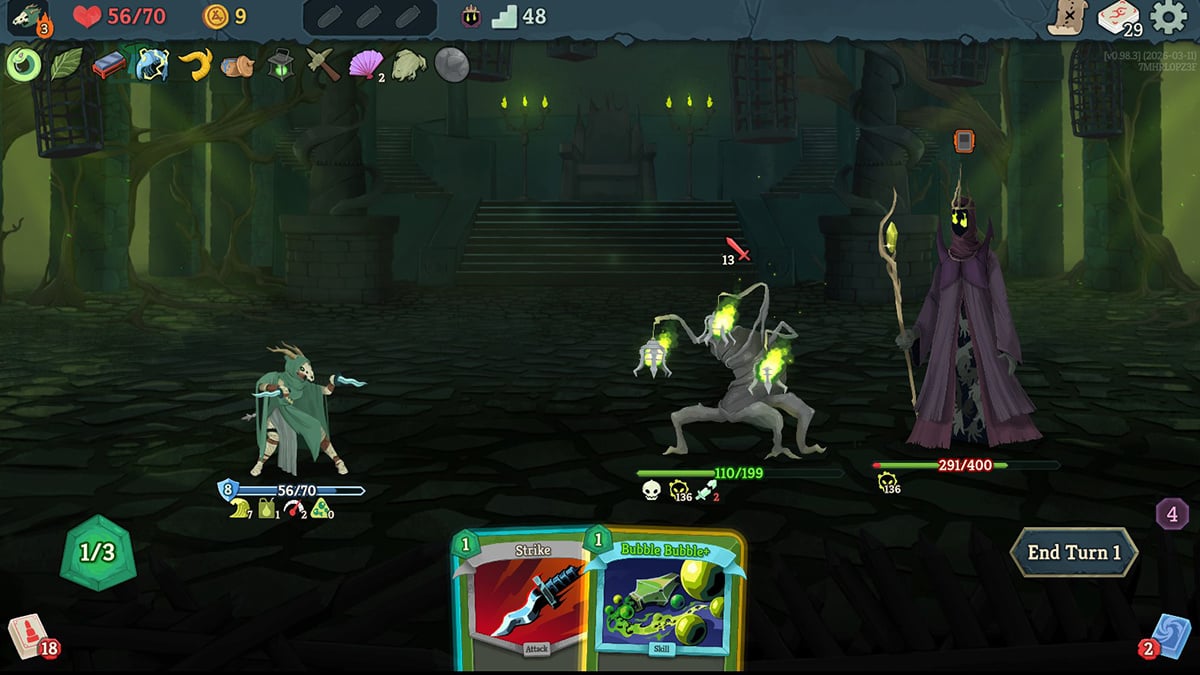
Slay the Spire 2 is the long-awaited sequel to one of the most influential roguelike deck-building games ever made. Developed by Mega Crit, the game builds on the systems that made the original Slay the Spire a genre-defining hit while expanding the roster of playable characters, adding cooperative multiplayer, and introducing new mechanics designed to make every run feel different.
The sequel launched in early access on March 5, 2026 for Windows, macOS, and Linux. Even in its early access state, the game is already feature-rich and extremely popular, reaching hundreds of thousands of concurrent players shortly after launch. The early access period is primarily focused on balance changes, tuning, and expanding content, meaning character strength and strategies may evolve as new cards, relics, and mechanics are added.
At its core, Slay the Spire 2 follows the same roguelike structure as the original game. Players choose a character, climb a procedurally generated tower filled with enemies and events, and build a deck of cards along the way. Each run forces players to adapt as they acquire new cards, relics, and upgrades while trying to survive increasingly difficult encounters. A single defeat ends the run, but progress unlocks new tools, story elements, and gameplay options for future attempts.
One of the most important decisions players make at the start of each run is which character to play. Each hero has their own starting deck, unique mechanics, and specialized card pool. These differences dramatically change how a run unfolds, which is why tier lists quickly become a hot topic in the community.
This guide breaks down the best characters in Slay the Spire 2 and ranks them based on consistency, power scaling, and flexibility during a run.
How Many Characters Are in Slay the Spire 2?
At launch, Slay the Spire 2 features five playable characters. Three are returning favorites from the original game, while two are completely new additions designed specifically for the sequel’s mechanics.
The current roster includes:
- Ironclad
- Silent
- Necrobinder
- Regent
- Defect
Each character begins a run with their own unique starting deck and card pool, which determines the strategies available to them throughout the climb.
Veterans of the original game will immediately recognize Ironclad, Silent, and Defect, all of whom return with updated cards and balance adjustments. The sequel also introduces two new characters, Necrobinder and Regent, each built around entirely new mechanics that change how decks are constructed and played.
Players familiar with the first game may also remember Watcher, a monk-style character introduced later in Slay the Spire. Watcher is not currently playable in Slay the Spire 2, but many fans expect the character to return in a future update during the early access development period. As new characters are added, the tier list will be updated to reflect how they compare with the existing roster.
Next, we will break down each character’s strengths and weaknesses before ranking them in the Slay the Spire 2 character tier list.
Slay the Spire 2 character tier list
With the current roster established, we can now rank each character based on overall power, consistency, and how reliably they can complete runs in the game’s current state, while also explaining why each one lands where it does through a deeper look at their mechanics, strengths, and weaknesses.
1. Necrobinder (S+ tier)

Necrobinder currently sits at the top of the tier list as the most powerful and consistent character in Slay the Spire 2. While other classes can reach similar power levels with the right setup, Necrobinder stands out because it can reliably scale into a winning position in nearly every run.
The biggest reason for this is how its core mechanic functions. Unlike characters such as Defect, which can struggle early without the right cards, Necrobinder naturally builds strength as fights go on. Its baseline gameplay loop generates value without needing specific rares, which makes Act 1 significantly safer and more consistent. You are far less likely to lose runs early simply due to bad card rewards.
Necrobinder also excels at scaling into the late game. Many of its builds revolve around generating and leveraging its unique resources, allowing it to snowball quickly once a few key pieces are in place. Even common cards contribute to this scaling, which reduces reliance on high roll scenarios. This is a major contrast to characters like Regent, who can deal massive damage but only if the correct pieces come together.
A major part of that strength comes from how flexible Soul is. Soul tokens cost 0, draw 2 cards, and exhaust, which effectively turns them into delayed card draw that can be banked for the right turn. That flexibility allows Necrobinder to smooth out bad draws and consistently find the cards it needs, whether that is block, damage, or energy. This makes the class far less prone to losing runs due to variance.
Its other defining mechanic is Osty, the bone hand. Osty only attacks when enabled by specific cards, but that design gives Necrobinder a lot of control over how fights play out. Summon acts like stored block, letting you prepare for future turns, while Osty attack cards convert that stored value into damage when needed. This balance between defense and offense is one of the reasons the class feels so stable across different stages of a run.
The strongest builds are also very easy to identify and draft into:
- Soul engine: Uses cards like Soultorm, Haunt, Devour Life, Dirge, Severance, and Capture Spirit to generate constant card draw, scaling damage, and sustain
- Osty attack: Chains cards like Squeeze, Rattle, Sic ’Em, Flatten, and Fetch to rapidly stack damage while generating enough Summon to stay protected
- Ethereal (situational): Can be powerful with cards like Banshee’s Cry and Pagestorm, but depends on seeing enough Ethereal support
- Big damage: Uses Lethality, Eradicate, and Vulnerable to create large burst turns, but is less consistent than the main builds
- Doom (weak): Works as supplemental value on some cards but is not reliable as a primary scaling strategy
Necrobinder earns its S+ placement because it offers unmatched consistency, multiple reliable build paths, and one of the strongest scaling engines in the game. It does not require perfect card rewards to succeed, and that level of reliability makes it the strongest character in the current version of Slay the Spire 2.
2. Silent (S tier)

Silent earns S tier because her discard package is one of the strongest and most reliable playstyles in Slay the Spire 2 right now. She has the tools to build small, efficient decks, line up her best cards consistently, and convert that consistency into both damage and defense. Compared with most other characters, Silent feels less dependent on rare high rolls and more capable of forcing a winning run through strong commons and uncommons alone.
Her starting relic, Ring of the Snake, is a major reason why she feels so stable. Drawing 2 additional cards at the start of combat gives Silent better opening turns than almost any other character. That extra consistency matters a lot because many of her best decks revolve around finding key combo pieces quickly, especially in the early turns where fights are often decided.
What makes Silent especially strong is how well her card pool supports one clear game plan. Discard is not just a side mechanic. It is the backbone of her best builds. Cards like Acrobatics and Prepared are premium enablers because they help cycle the deck, trigger discard payoffs, and line up stronger turns. Once those are in place, payoff cards such as Reflex, Tactician, Pinpoint, Untouchable, and Tools of the Trade start pushing the deck into absurd territory. Well-Laid Plans is also one of her best cards because retain makes it much easier to hold combo pieces until the exact turn they matter.
Silent also has strong support cards that make runs safer while the engine is coming together. Backstab helps stabilize the early game with front-loaded damage. Leg Sweep and Piercing Wail are excellent defensive picks that can carry difficult fights on their own. Expose gives her another powerful way to push tempo by stripping block and artifact while applying Vulnerable. Even when Silent is not fully assembled, cards like these keep her from falling behind.
The main reason Silent does not take the top spot is that her strongest builds are still somewhat tied to discard synergies and current balance. Shiv and poison strategies exist, but they generally feel less reliable or less rewarding than the discard shell. That means Silent is extremely powerful, but also a little narrower than Necrobinder at the moment.
Common Silent build paths include:
- Discard engine: Built around Acrobatics, Prepared, Reflex, Tactician, and Tools of the Trade, then finished with cards like Pinpoint or Untouchable
- Discard control: Uses the same engine pieces, but leans more on Leg Sweep, Piercing Wail, Well-Laid Plans, and Expose to survive while scaling
- Sly payoff builds: Makes strong use of Untouchable, Flick-Flack, Ricochet, and Haze, with discard cards enabling them efficiently
- Poison support builds: Usually more supplemental than central, relying on cards like Noxious Fumes or Corrosive Wave rather than going all-in on poison
Silent is one of the easiest characters to recommend to players who want strong, repeatable runs. She has consistency, scaling, defense, and explosive payoff, all backed by one of the best starting relics in the game. When her discard pieces come together, she feels oppressive, and that is why she firmly belongs in S tier.
3. Ironclad (A tier)

Ironclad remains a dependable pick that can handle most runs without much friction, but it does not reach the same level of consistency or scaling control as the top tiers. Its strength comes from durability and straightforward power, not from building intricate engines.
The starting relic, Burning Blood, heals 6 HP after each combat. That sustain changes how you approach the map. You can take more elite fights early, accept a bit more damage in exchange for faster clears, and still recover. This often leads to stronger relic setups going into later acts.
Ironclad’s card pool supports simple, effective strategies. You do not need perfect synergy to get through Act 1 and Act 2. Cards like Bash and Uppercut apply Vulnerable, which amplifies all incoming damage and makes even basic attacks hit much harder. Early pickups such as Carnage, Hemokinesis, and Pommel Strike provide immediate damage and help stabilize fights before enemies can scale.
Where Ironclad starts to separate itself is in strength scaling. Cards like Inflame, Spot Weakness, and Demon Form allow your damage to grow over time, turning even basic attacks into serious threats. Once strength is stacked, multi-hit cards such as Sword Boomerang or Pummel become extremely efficient and can close fights quickly.
Defensively, Ironclad has access to some of the most efficient block tools in the game. Shrug It Off is a strong early pick because it provides both block and card draw. Flame Barrier adds damage on top of defense, which is especially useful in multi-hit fights. Reaper is one of the most valuable cards in longer runs, since it converts damage into healing and pairs extremely well with strength scaling.
The limitation comes from how linear these strategies can feel. Ironclad does not manipulate its deck as easily as Silent, nor does it build resource engines as naturally as Necrobinder. If you do not find scaling pieces like Demon Form or consistent strength gain, your damage can fall behind in later acts.
Typical Ironclad build paths include:
- Strength scaling: Built around Inflame, Spot Weakness, and Demon Form, then converted into damage with cards like Pummel or Sword Boomerang
- Heavy attack builds: Focuses on high-impact cards such as Carnage and Bludgeon, often paired with Bash or Uppercut for Vulnerable
- Sustain builds: Uses Reaper, Burning Blood, and high damage output to recover HP and stay ahead over long fights
- Balanced builds: Combines Shrug It Off, Flame Barrier, and consistent damage cards for a stable, flexible deck
Ironclad succeeds by being reliable and forgiving. It gives you room to make mistakes and still recover, which is valuable in a game where small errors can snowball. At the same time, it does not offer the same level of control or inevitability as higher-tier characters, which keeps it just below the top.
4. Defect (B+ tier)

Defect has one of the highest ceilings in the game, but it sits in B+ tier because it takes more effort and better card rewards to reach that ceiling consistently. When the pieces come together, it can feel unstoppable. The issue is getting there without falling behind.
Its starting relic, Cracked Core, channels a Lightning orb at the start of combat. This gives you passive damage every turn, which helps smooth out early fights. It is useful, but not enough on its own. Defect needs additional support quickly or it starts to feel underpowered compared to other characters.
The core of Defect revolves around orb generation and scaling. Cards like Ball Lightning, Cold Snap, and Doom and Gloom help you build up orbs early while still dealing damage. These are some of the most important early picks because they stabilize your runs and give you direction.
From there, scaling becomes the priority. Defragment is one of the best cards you can find, as it increases Focus and boosts the effectiveness of all your orbs. Biased Cognition can take this even further, giving a massive short-term spike in power that can win fights quickly. Once Focus is online, even simple Frost or Lightning setups become extremely strong.
Defect also benefits heavily from card draw and energy support. Cards like Coolheaded provide both block and draw, helping you cycle your deck while staying alive. Compile Driver can generate large bursts of card draw if you have multiple orb types. On the energy side, Turbo and Double Energy enable stronger turns and allow you to fully capitalize on your setup.
One of Defect’s biggest strengths is how explosive it can become once the engine is built. Cards like Electrodynamics allow Lightning orbs to hit all enemies, turning your passive damage into powerful AoE. Echo Form is another key card that can double your most important plays each turn, pushing your scaling even further.
The downside is consistency. Without early orb generation or Focus scaling, your deck can feel weak and unfocused. You often need a few specific cards to make your build work, and missing them can result in slow or unstable runs. Compared to Silent or Necrobinder, you have less control over how your deck develops.
Common Defect build paths include:
- Orb scaling: Built around Ball Lightning, Cold Snap, and Doom and Gloom, then enhanced with Defragment or Biased Cognition
- Focus scaling: Prioritizes Defragment and similar effects to amplify all orb output into strong late-game damage and block
- Cycle builds: Uses Coolheaded, Compile Driver, and other draw tools to repeatedly trigger orb effects
- Power builds: Relies on cards like Electrodynamics and Echo Form to scale quickly and dominate longer fights
Defect rewards good drafting and planning, but it asks more from the player than most other characters. When it works, it feels like one of the strongest characters in the game. When it does not, runs can fall apart quickly. That gap between best-case and average performance is what keeps it in B+ tier.
5. Regent (B tier)

Regent ranks at the bottom of the current tier list, not because it lacks power, but because it is the least consistent when it comes to turning that power into reliable wins. It can produce some of the highest burst damage in the game, but only when the right pieces come together.
Its starting relic, Divine Right, grants three Star Regent resources at the start of each combat. This gives you immediate access to your core mechanic, but those resources need proper payoffs to matter. On their own, they do not provide the same baseline value that other characters get from their relics.
The main strength of Regent is its ability to convert those resources into explosive turns. Cards that scale off Star Regent or amplify damage can quickly push your output into one-shot territory. When this works, fights end before enemies can become a problem.
Key damage cards like Celestial Strike, Astral Slam, and Cosmic Wrath are examples of what Regent wants to be doing. These cards reward you for having resources available and can deal massive burst damage when combined correctly. Support cards such as Starfall or Heaven’s Boon help generate or maintain resources so you can keep those turns going.
The issue is that Regent often needs both sides of the equation. If you draw resource generation without payoff cards, your turns feel weak. If you draw damage without enough resources, you cannot fully use those cards. This mismatch shows up most in Act 1, where consistency matters the most.
Defensively, Regent can struggle compared to other characters. Cards like Divine Guard and Starlight Barrier provide block, but they are not always enough unless your deck is already functioning well. Unlike Ironclad or Silent, Regent does not have as many low-cost, reliable defensive options to fall back on.
There are still strong build paths when things line up:
- Burst damage builds: Uses cards like Celestial Strike and Astral Slam to convert resources into large damage spikes
- Resource scaling builds: Focuses on cards such as Starfall and Heaven’s Boon to maintain a steady flow of Star Regent resources
- Combo builds: Chains resource generation with high-impact cards like Cosmic Wrath for explosive turns
- Balanced builds: Mixes damage and defense with cards like Divine Guard to survive while setting up stronger turns
Regent can feel extremely powerful when you assemble the right deck, but it asks more from your card rewards than any other character. Other classes provide more stable paths to victory, which is why Regent remains in B tier despite its high damage potential.
Conclusion
Slay the Spire 2’s current character balance leans heavily toward consistency and scalability. Necrobinder and Silent stand out because they can reliably build toward a winning position in almost every run, with strong core mechanics that smooth out bad draws and reduce reliance on perfect card rewards. Ironclad and Defect remain solid choices, but they require either stronger scaling pieces or better drafting to reach the same level of performance. Regent, while capable of extremely high damage, is still the most dependent on finding the right combinations, which makes it less consistent overall.
As the game continues through early access, these rankings will likely shift. Balance changes, new cards, and potential character additions could significantly alter how each class performs. For now, players looking for the most reliable runs should prioritize characters with strong built-in engines and flexible scaling options.
If you want to improve your runs even further, the next step is understanding which cards to prioritize. Be sure to check out my Slay the Spire 2 Best Cards guide, where I break down the strongest picks across all characters and explain how to build around them effectively.
FAQ
What is the best character in Slay the Spire 2 right now?
Necrobinder is currently the strongest character due to its consistency, flexible scaling, and ability to build powerful engines without relying on rare cards.
Which character is the easiest for beginners?
Silent and Ironclad are the most beginner-friendly. Silent offers strong consistency through card draw and discard, while Ironclad provides sustain through Burning Blood, making mistakes less punishing.
Why is Necrobinder ranked higher than Silent?
Both are very strong, but Necrobinder is slightly more consistent. Its Soul mechanic reduces bad draws, and its overall game plan is easier to execute across most runs.
Is Defect weak in Slay the Spire 2?
Defect is not weak, but it is more dependent on getting the right cards. Without early orb generation or scaling like Defragment, runs can feel inconsistent compared to other characters.
Why is Regent ranked the lowest?
Regent has high damage potential but relies heavily on drawing the right combinations of cards. This makes it less reliable, especially in early acts where consistency matters most.
What is the most reliable build in the game right now?
Necrobinder’s Soul-based engine is the most reliable. It provides consistent card draw, scaling, and survivability without requiring specific rare cards.
Are all builds viable for every character?
Not really. Each character has a few standout strategies that are much stronger than others. For example, Silent performs best with discard builds, while Necrobinder excels with Soul and Osty-focused setups.
Will this tier list change over time?
Yes. Slay the Spire 2 is still in early access, so balance changes, new cards, and future updates will likely shift the rankings.
How can I improve my runs quickly?
Focus on drafting cards that support a clear build early, rather than taking generally “good” cards. Consistency and synergy matter more than raw power.
Recommended Products

Nitro V 15 (RTX 5050)
Buy Now |

Acer Nitro V 16S AI (RTX 5060)
Buy Now |

Predator Triton 14 AI (RTX 5070)
Buy Now |
|---|