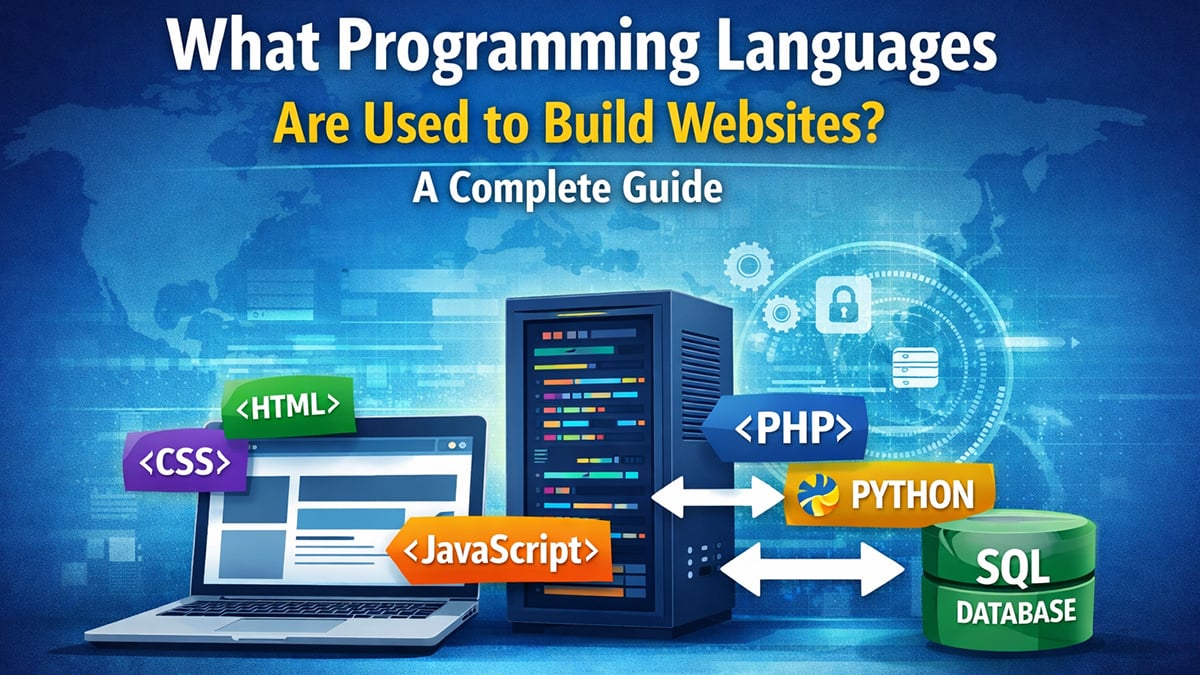
What programming languages are used to build websites, and why do modern sites rely on more than just one? From the pages you see in your browser to the servers that process logins, payments, and data in the background, every website is powered by a stack of specialized languages working together. Understanding how HTML, CSS, JavaScript, and server-side languages like Python, PHP, and Java fit into that stack is the first step to understanding how the modern web actually works.
What is a website, in technical terms
A website is not a single program. It is a distributed software system made up of three main parts that communicate over the internet.
When you type a web address into your browser, your computer sends a request to a remote server. That server runs software written in a back-end programming language. It decides what data you are allowed to see, pulls information from a database, and sends a response back to your browser. Your browser then uses front-end languages to turn that response into the page you see on screen.
In practical terms, every modern website consists of:
- Client-side code running in your browser (HTML, CSS, JavaScript)
- Server-side code running on a remote machine (Python, PHP, Java, Node.js, etc.)
- A database that stores users, content, and transactions (SQL)
This separation is why a site can look simple but still be technically complex. A login form, for example, is built with HTML and CSS, validated with JavaScript, processed by a back-end language, and finally verified against a database before you are allowed in.
Once you understand this layered structure, the role of each programming language becomes much easier to see.
Front-end languages (what users see and interact with)
The front end of a website is everything that runs inside your web browser. This is the part users directly see, click, scroll, and type into. No matter what framework or platform a site uses, every front end is built on the same three core languages.
HTML is the foundation. It defines the structure of a web page. Headings, paragraphs, images, buttons, forms, and links are all created using HTML. Without it, a browser would have no idea what content exists on the page.
CSS controls how that structure looks. It handles layout, colors, fonts, spacing, animations, and how a site adapts to different screen sizes. A site without CSS still works, but it looks like a plain text document.
JavaScript controls behavior. It makes pages interactive and dynamic. When a menu opens, a form checks your input, or new content loads without refreshing the page, JavaScript is responsible.
Together, these three languages turn raw data into a usable website. Modern frameworks like React, Vue, and Angular are built on top of JavaScript, but they do not replace HTML, CSS, or JavaScript. They simply make large, complex sites easier to manage.
Back-end languages (what runs on the server)
While the front end runs in your browser, the back end runs on a remote server. This is where the real logic of a website lives. Every time you log in, submit a form, make a payment, or load personalized content, you are interacting with back-end code.
Back-end programming languages handle tasks such as:
- Checking usernames and passwords
- Managing user accounts and permissions
- Processing payments and orders
- Sending and receiving data from databases
- Communicating with other services through APIs
Several languages dominate modern web servers.
JavaScript (Node.js) allows developers to use JavaScript on both the front end and the back end. This makes it popular for startups and real-time applications.
Python is widely used for web APIs, data-driven websites, and automation. Frameworks like Django and Flask make it easy to build reliable server software.
PHP powers a large portion of the web, including WordPress, which runs millions of business and news sites.
Java and C# are common in enterprise and corporate systems where reliability, security, and long-term support matter.
Go is increasingly used for high-performance services that need to handle massive traffic efficiently.
The browser never sees this code directly. It only receives the results, usually in the form of web pages or data that JavaScript can process.
Databases and data languages
Websites are not just pages. They are data systems. User accounts, articles, messages, orders, and game stats all have to be stored somewhere, and that is the role of the database.
Most websites use one of two types of databases.
SQL databases store data in structured tables with rows and columns. They use a language called SQL (Structured Query Language) to read and write data. Popular SQL databases include MySQL, PostgreSQL, and Microsoft SQL Server. These are commonly used for things like user profiles, product catalogs, and financial records.
NoSQL databases store data in more flexible formats, such as documents or key-value pairs. MongoDB, Redis, and Firebase are popular examples. These are often used for fast-moving data, real-time apps, or systems that need to scale quickly.
Back-end programming languages talk to databases using SQL or database-specific query languages. When you log in to a website, the server sends a query to the database to check whether your username and password match what is stored. When you post a comment or buy something, new data is written back into the database.
Without database languages, websites would not be able to remember anything about you once the page reloads.
How these languages work together in a real website
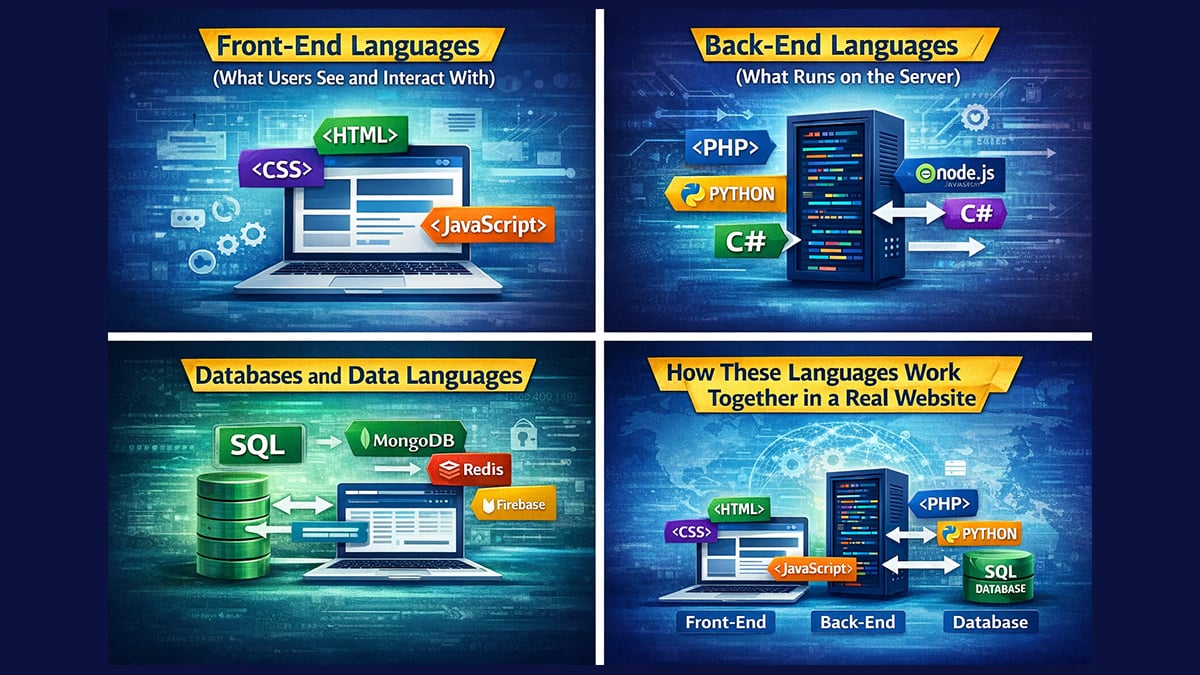
A modern website is built as a stack, meaning several languages and systems are layered on top of each other to deliver one experience.
When you open a page, your browser downloads HTML, CSS, and JavaScript from a server. The browser uses HTML to build the page structure, CSS to style it, and JavaScript to make it interactive.
When you click a button, submit a form, or log in, JavaScript sends a request to the server. That request is handled by a back-end language such as Python, PHP, or Node.js. The server may then query a database using SQL or another data language, retrieve the information it needs, and send a response back to the browser.
The browser never talks to the database directly. It only talks to the server. The server acts as the gatekeeper that enforces rules, protects data, and decides what each user is allowed to see.
This separation is what makes modern websites both powerful and secure. Each layer does one job, and together they create the full experience.
Do you need to learn all of these languages?
No single person has to master every language used in web development. The stack is divided so that different roles can focus on different layers.
If you want to work on how websites look and feel, you focus on HTML, CSS, and JavaScript. These are the core front-end languages, and they are required no matter which framework you use.
If you want to work on how websites process data, handle users, or run behind the scenes, you focus on a back-end language such as Python, PHP, JavaScript (Node.js), or C# along with a database language like SQL.
Some developers become full-stack developers, meaning they work across both sides. Others specialize in one area. Large companies almost always split this work between teams because modern websites are too complex for one person to handle efficiently.
The important point is that every website, from a simple blog to a global e-commerce platform, is built from the same core language layers. The difference is how much logic and scale is added on top.
Why modern websites use multiple programming languages
Using several programming languages is not over-engineering. It is a necessity driven by how the web works.
Browsers are designed to understand only a small set of languages for security and compatibility reasons: HTML, CSS, and JavaScript. That makes them fast, stable, and safe for users. Servers, on the other hand, are designed to run powerful programming languages that can handle databases, encryption, payments, and business logic.
Trying to do everything in one language would either make websites insecure or make them slow and inflexible. By separating responsibilities, each language is used where it is strongest.
Front-end languages are optimized for:
- Displaying content
- Handling user input
- Running safely on millions of different devices
Back-end languages are optimized for:
- Processing data
- Enforcing rules and permissions
- Scaling to millions of users
Database languages are optimized for:
- Storing large volumes of information
- Retrieving data quickly
- Preserving accuracy and integrity
This layered design is why modern websites can be both visually rich and technically reliable at the same time.
Which programming languages should you learn first?
If your goal is to build real websites, there is a clear and practical learning order.
Start with HTML and CSS. These teach you how web pages are structured and styled. You cannot skip them because every website, no matter how advanced, is built on top of HTML and CSS.
Next, learn JavaScript. This is what turns a static page into an interactive application. JavaScript is also the most important language in modern web development because it runs in the browser and, through Node.js, on the server as well.
Once you are comfortable with JavaScript, choose one back-end language. Python, PHP, or JavaScript (Node.js) are all good options. What matters is understanding how servers handle requests, users, and data, not which specific language you pick.
Finally, learn SQL. Even if you later use NoSQL systems, SQL teaches you how data is structured, queried, and protected. This is a core skill for anyone building real applications.
This path mirrors how the web itself is built: structure first, behavior second, server logic third, and data last.
For developers who value portability without sacrificing performance, a lightweight laptop like the best Acer laptop for coding can make a big difference in workflow and productivity.
FAQ
Do you need to know multiple programming languages to build a website?
Yes. At a minimum, every website requires HTML, CSS, and JavaScript for the front end. If the site stores data, has logins, or processes payments, it also needs a back-end language and a database.
Is JavaScript required for all websites?
Technically no, but in practice yes. A site can exist with just HTML and CSS, but modern features such as forms, dynamic content, search, and user accounts all depend on JavaScript.
What is the most important programming language for web development?
JavaScript is the most important because it runs in every browser and can also run on servers through Node.js. It connects the front end and the back end.
Can one person build a full website alone?
Yes. Many developers work as full-stack developers, meaning they write the front end, back end, and database code themselves. Larger companies usually split this work across teams.
What is the easiest programming language to start with?
HTML and CSS are the easiest because they focus on structure and design rather than logic. JavaScript is the next step once you understand how web pages are built.
Do you need a powerful computer to do web development?
No. Web development does not require a gaming PC. A modern lightweight laptop with enough RAM to run a browser, a code editor, and a local server is more than sufficient for most web development work.
Are frameworks like React or Vue required?
No. They are tools built on top of JavaScript that help manage large projects. You can build fully functional websites using plain JavaScript, HTML, and CSS.
What language talks directly to the database?
The back-end language communicates with the database using SQL or a database-specific query system. The browser never connects to the database directly for security reasons.
Recommended Products