AI workstations are becoming a core part of modern business computing, and today we’ll discover their role in the workplace. On top of that we’ll cover the rise of AI, what AI workstations are designed to do, what they will and will not replace, and how Acer AI workstations support professional and enterprise workflows.
Artificial intelligence is no longer limited to research labs or cloud platforms. AI tools are now embedded in everyday professional workflows, from engineering and design to content creation and data analysis. As adoption accelerates, businesses worldwide are reassessing where AI workloads should run and what kind of hardware is required to support them.
This has led to growing interest in AI workstations, purpose-built systems designed to deliver local, on-premises AI performance for demanding professional use.
AI’s shift from experimentation to daily utility has changed our expectations around performance, security, and cost control. Organizations large and small increasingly require predictable AI capability without continuous cloud dependence, particularly when working with proprietary data or regulated workloads. Let’s get the lowdown on the rise of AI at work!
The rise of AI workstations in professional computing
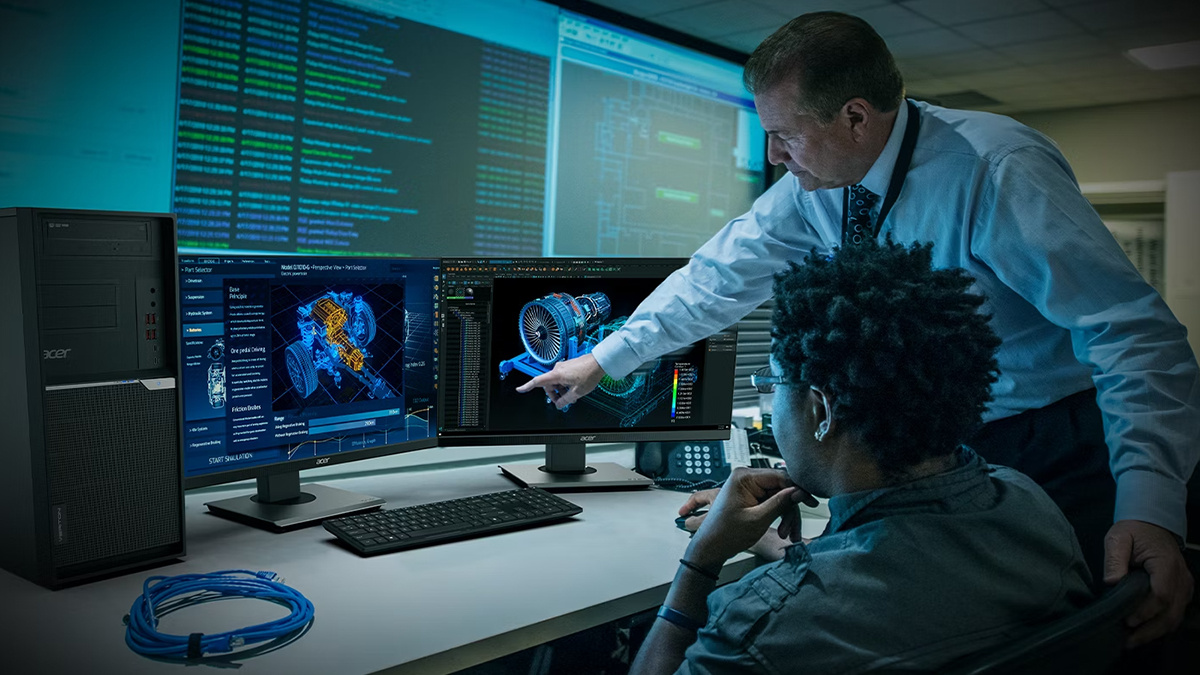
AI is now used across industries to speed up workflows, improve accuracy, and unlock new capabilities. Engineers use AI-assisted simulation and analysis tools, designers rely on generative models for visual assets, and researchers run local experiments to refine models before deployment. These tasks place sustained pressure on compute resources in ways traditional office desktops weren’t designed to handle.
Cloud AI services remain valuable, but they introduce recurring costs, latency, and data governance challenges. For many teams, especially smaller groups or individual departments within larger organizations, running AI workloads locally is just more practical. Advances in processors, accelerators, and system architectures have made this feasible, paving the way for AI workstations to move from niche tools to mainstream professional hardware.
What are AI workstations?
Short answer: Professional desktop systems designed specifically for AI-centric workloads such as model inference, training, simulation, and AI-accelerated content creation. AI workstations go beyond standard workstations by integrating hardware and software optimized for machine learning frameworks and generative AI tools.
These systems are built to sustain heavy computational loads over long periods, providing consistent performance for professionals who rely on AI for their daily work. Rather than focusing on general productivity tasks, AI workstations prioritize throughput, memory bandwidth, and acceleration for complex data processing. In practical terms, an AI workstation allows teams to run advanced AI workloads locally, reducing dependence on shared servers or external cloud infrastructure.
What are AI workstations specialized to do?
AI workstations are optimized for tasks that exceed the capabilities of conventional business desktops. Typical use cases include:
- Running large AI models locally for inference and experimentation
- Training and fine-tuning models within controlled environments
- Generative AI workflows for image, video, and 3D asset creation
- Engineering simulations and data analysis accelerated by AI
- Secure, on-premises processing for sensitive or regulated workloads
These workloads require sustained parallel processing and fast access to memory, both of which are core design priorities for AI workstations.
Will AI workstations replace work computers?
Probably not, and that distinction matters. Most employees simply do not need the level of AI performance offered by a workstation. Everyday tasks such as email, document editing, video conferencing, and browser-based applications are well served by standard business desktops and laptops. Deploying AI workstations across an entire organization would increase costs without delivering meaningful benefits for most users.
AI workstations are designed to complement existing systems, not replace them wholesale. They fill specific roles where AI workloads are central to productivity and where in-house performance provides clear advantages.
What will AI workstations replace?

AI workstations are more likely to displace targeted infrastructure rather than everyday work PCs. In many cases, they can reduce the need for, or replace:
• Entry-level AI servers used by small teams
• Shared GPU systems that create performance bottlenecks
• Cloud-based AI compute for development and testing
• External AI services used for sensitive or proprietary data
By bringing AI processing closer to the user, these systems can lower long-term costs, improve responsiveness, and simplify data governance. For teams experimenting with AI or running ongoing workloads, a dedicated workstation can be a more efficient solution than renting remote compute resources.
Acer Veriton AI Workstations
Acer’s Veriton workstation lineup is designed to address a range of AI and professional workloads, from compact, on-premises AI systems to expandable tower workstations for demanding environments. The focus is on practical AI deployment, secure business use, and scalability.
1. Acer Veriton GN100 AI Mini Workstation

The Acer Veriton GN100 AI Mini Workstation is a compact, on-premises AI system built around the NVIDIA GB10 Grace Blackwell Superchip from NVIDIA’s DGX Spark platform. This superchip features 128GB of unified memory, up to 4TB of NVMe M.2 SSD storage, and up to 1 petaFlop of powerful AI computer performance.
This workstation is designed to deliver high levels of AI performance in a small form factor, supporting local execution of large AI models. By enabling AI workloads to run on-site, it reduces reliance on cloud services and helps organizations manage costs and data security more effectively.
The GN100 is well suited to AI development, experimentation, and creative workflows that benefit from low latency and predictable performance without requiring a full server deployment.
2. Acer Veriton RA100 AI Mini Workstation

Next, the Acer Veriton RA100 AI Mini Workstation focuses on efficient, intelligent workflows powered by the AMD Ryzen AI Max+ 395 processor. This CPU is complemented by Radeon™ 8060S Graphics, and 50 NPU TOPS, delivering up to 120B parameters for demanding workloads and local AI models. As a Copilot+ PC, it is designed to support modern AI-assisted applications used in professional environments.
This compact workstation targets users working with local AI models, generative AI tools, 3D design, and content creation. Its small footprint makes it easy to deploy in studios or technical teams, while its AI capabilities support workflows that blend productivity and creativity.
3. Acer Veriton Vero 8000 Compact Tower Workstation

Moving on, the Acer Veriton Vero 8000 Compact Tower Workstation is an AI-ready business desktop built for professional use. Powered by Intel Core Ultra processors (Series 2) with vPro, it combines AI acceleration with advanced security and enterprise connectivity. The Intel Core Ultra processors support up to Intel Core Ultra 9 and AI acceleration, while the integrated NPU delivers up to 13.1 TOPs, enhancing your business’s productivity and performance.
Designed for applications such as 3D content creation and CAD, this system balances desk-friendly sizing with the ability to expand memory, storage, and graphics as workloads evolve.
4. Acer Veriton Vero 8000 Mid Tower Workstation

Last but not least, the Acer Veriton Vero 8000 Mid Tower Workstation extends the platform with greater expansion potential and a focus on sustainability. EPEAT certification, post-consumer recycled plastics in the chassis, and fully recyclable packaging support organizations with environmental goals. Centered around the latest Intel Core processors (14th Gen) with vPro1, the Acer Veriton Vero Desktop is designed for AI-ready performance. Need more? Expand your horizon with the optional Nvidia RTX or Intel Arc graphics.
Like the compact version, it uses Intel Core Ultra processors with vPro to deliver AI acceleration, security, and connectivity for demanding professional workloads.
The role of AI workstations
AI workstations are not designed to replace everyday work computers, and they do not need to. Their role is far more targeted, supporting professionals and teams that rely on local AI processing, accelerated workloads, and secure, on-premises computing.
As AI becomes a practical tool across engineering, design, research, and content creation, these systems help bridge the gap between standard office PCs and full-scale server or cloud infrastructure.
Acer’s Veriton AI workstation lineup reflects this shift, offering scalable options that deliver focused AI performance where it is genuinely needed, without overextending complexity or cost.
FAQs
What is an AI workstation?
A professional desktop designed for AI workloads such as local model processing, generative AI, and heavy compute tasks.
Will an AI workstation replace my work computer?
Probably not. Most everyday work does not require this level of performance.
What do AI workstations replace?
They can reduce the need for entry-level AI servers or cloud-based AI compute for development and testing.
Who are AI workstations for?
They are built for professionals such as engineers, designers, researchers, and technical teams using AI as part of their workflow.
Do AI workstations need cloud services?
Not always. Many AI tasks can run locally, reducing reliance on cloud services.
Recommended Products

Veriton AI Mini Workstation - VGN100-UD11 (GB20B)
Buy Now |

Predator Orion 7000 (RTX 5080)
Buy Now |

Predator Helios 18 AI (RTX 5090)
Buy Now |
|---|