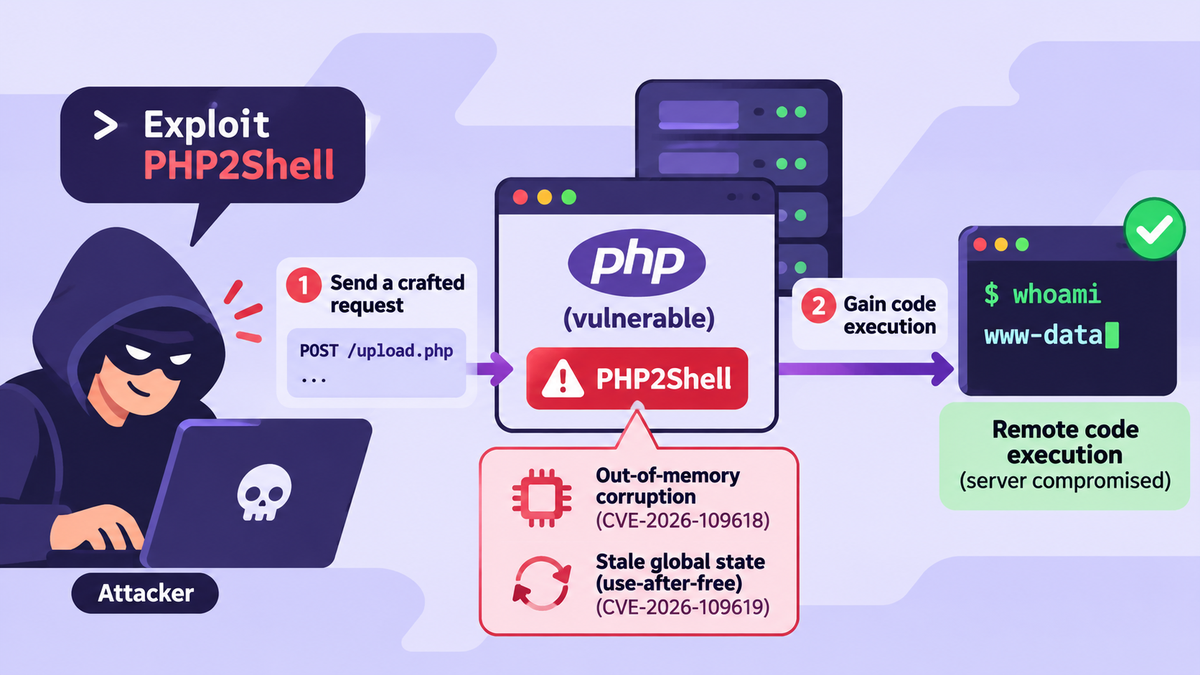
PHP2Shell is the nickname for two critical security flaws in PHP, the programming language that runs roughly 70% of all websites, including most WordPress, Drupal, Joomla and Magento sites. The flaws, tracked as CVE-2026-109618 and CVE-2026-109619, let an attacker run their own code on a vulnerable web server without logging in. Details leaked a day before the fix was ready, PHP shipped emergency patches on October 21, 2026, and attacks are already underway. You cannot patch PHP yourself as a visitor, but you can protect your accounts, your money and your own computer while website owners catch up.
What is PHP2Shell? PHP2Shell is a pair of remote code execution (RCE) vulnerabilities in PHP itself, not in any single website or plugin. According to watchTowr's PHP2Shell FAQ , both flaws let an unauthenticated attacker run their own code on a server running PHP, potentially taking control of it. Each carries a CVSS v4.0 score of 9.2 out of 10, which puts them firmly in the critical range.
The name says it all. "Shell" is shorthand for command-line access to a server, so PHP2Shell means a path from PHP to full control of the machine behind a website.
The scope is unusually wide. PHP powers 69.3% of websites according to W3Techs figures cited by Island , and every PHP installation that serves web requests is in scope, whether it runs under PHP-FPM, Apache mod_php, php-cgi, LiteSpeed or FrankenPHP.
PHP branch
Status
Fixed version
8.5
Patched
8.5.12
8.4
Patched
8.4.27
8.3
Patched
8.3.36
8.2
Patched (end of life December 31, 2026)
8.2.35
7.4, 8.0, 8.1
No official release; source backports only
Upgrade or vendor backport
7.3 and older, including PHP 5
No fix available
Upgrade to a supported branch
That bottom half of the table is the real problem. A CybelAngel analysis of 2.24 million internet-facing PHP hosts found 59% running versions with no fix coming.
What caused the PHP2Shell vulnerability? Both flaws come from how PHP cleans up after a web request goes wrong, especially when it runs out of memory. Your website's own code can be perfectly sound and the server still vulnerable, because the bug sits in the PHP engine underneath it.
Here is what each flaw does, in plain terms:
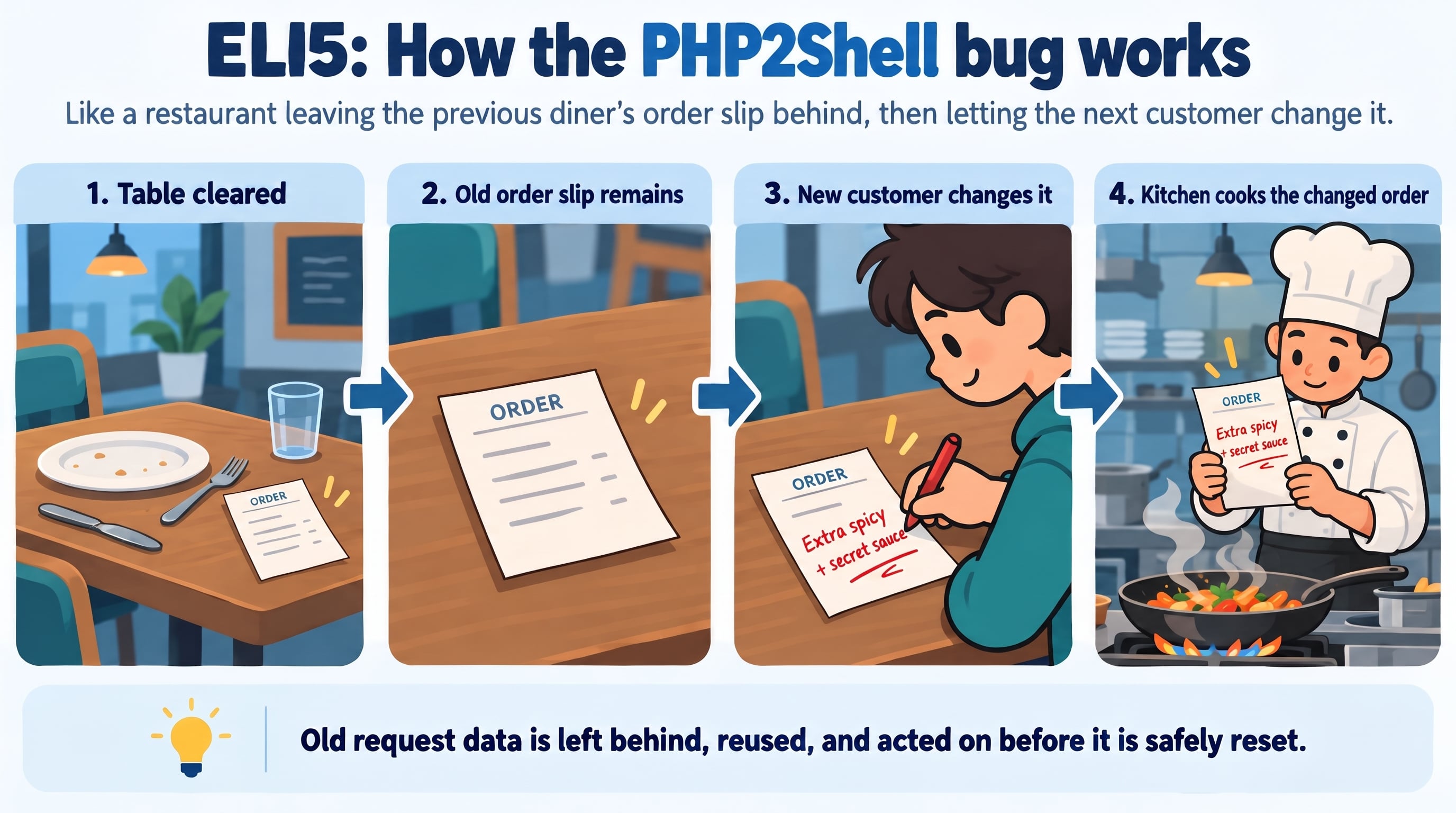
CVE-2026-109618 (out-of-memory corruption): If PHP runs out of memory partway through setting up a request, it leaves internal data half built. The cleanup code then trusts that broken data as if it were valid, which opens a path to running attacker code.CVE-2026-109619 (stale global state): Some internal request data outlives the memory it points to. The next visitor's request handled by the same PHP worker can act on those leftovers before PHP resets them. Security agencies classify this as a use-after-free bug.Think of it like a restaurant that clears a table but leaves the previous diner's order slip on it. The next customer can scribble on that slip, and the kitchen will cook whatever it says.
According to Aikido's PHP2Shell breakdown , PHP's session upload progress feature is one confirmed route into the second flaw, and it is switched on by default. That is why so many servers are exposed without anyone having made a configuration mistake.
AI found the bug, and a leak forced the fix out early PHP2Shell is also one of the first internet-scale flaws found with heavy help from AI. Deseret News reports that Ryan Austin of the security firm Calif uncovered the problems with assistance from OpenAI's GPT-5.6 Sol during an audit in August. Newsweek notes that Wiz Research found the same flaws independently using several AI models, including Gemini 4 Argon.
The researchers reported privately so PHP could prepare patches before going public. That plan fell apart a few days early.
Date (2026)
What happened
October 22
Original planned disclosure date
October 21
PHP ships fixed versions 8.5.12, 8.4.27, 8.3.36 and 8.2.35; Cloudflare and watchTowr report attacks
October 20
Details leak on Hacker News and X; PHP announces an emergency release
October 17
Earliest exploitation attempt later found by Amazon Threat Intelligence
August 1
Calif finds the first flaw
The PHP2Shell Wikipedia entry notes that Calif also mistakenly released a proof-of-concept video, which added fuel to the leak.
How is PHP2Shell being exploited? Attackers are mass-scanning the internet for PHP servers and firing crafted web requests at them, hoping to plant a backdoor. Exploitation attempts began before the patch existed and turned into a flood within hours of the release.
According to SecurityWeek , Amazon traced the first attempt to October 17, while the flaws were still secret, and it came from a commercial anonymization network. Amazon now describes PHP2Shell as broadly exploited in the wild. Hadrian, Patchstack and Cloudflare also reported attempts hours before the fixes landed.
How attackers got a head start matters too. Per Wikipedia's PHP2Shell entry , one development platform shipped patched PHP builds early, which let attackers compare old and new code to work out what had been fixed.
What a typical attack looks like Scan: Botnets sweep huge ranges of internet addresses looking for servers that answer like PHP.Strike: A single specially crafted web request is sent to the server. No login and no user click are needed. Techzine reports that the Dutch NCSC says a simple POST request may be enough.Settle in: If it works, the attacker drops a web shell, a hidden page that acts as a permanent remote control for the server.Cash out: The server gets put to work for the attacker, from mining cryptocurrency to stealing data to serving malware to visitors.Techzine adds that early waves appear opportunistic and focused on web shells and cryptominers, with ransomware groups and state-backed hackers reportedly using the flaw to get a foothold. VulnCheck told SecurityWeek it saw at least one failed attempt to deploy a web shell.
Running code is not the only risk. SOCRadar notes that researchers showed attackers can also read PHP worker memory, which can hold passwords and API keys.
The good news, for now Not every attempt works. watchTowr told SecurityWeek that none of the proof-of-concept code circulating publicly actually achieves code execution. That gap will not last, so the safest assumption is that any unpatched PHP server is a target.
How does PHP2Shell affect everyday users? You do not run PHP on your laptop or phone, so PHP2Shell cannot infect your device directly. The danger is that websites you already trust can be quietly turned against you. As Malwarebytes puts it , you do not need to install PHP updates on your own device, but a trusted website may no longer be trustworthy.
Here is how a server-side bug ends up on your screen:
Fake login pages: A hacked site can swap its real sign-in page for a copy that sends your password straight to the attacker.Malware downloads: The site can offer a fake browser update or a booby-trapped document that looks exactly like what you expected.ClickFix tricks: Island's security research team warns about fake "verify you are human" prompts that tell you to press a few keys and paste a command, which then installs malware with no browser bug needed.Phishing email from real businesses: With control of a server, attackers can send email through the site's own mail setup, so messages arrive from a genuine domain and slip past filters.Stolen personal data: Code running on a store or service can read customer records, saved addresses and order histories.Outages: Sites you rely on may go dark for hours or days while they patch.The long tail is the worrying part. Island estimates that nearly half of all PHP sites run a version that no longer gets security updates, which works out to about a third of the web. Small business pages, school sites, local clubs and forgotten blogs may stay vulnerable for months, and those are exactly the sites attackers like to hijack because people trust them.
A temporarily offline site is not a sign it was hacked. In most cases it means the owner is being careful.
Which popular sites are affected by PHP2Shell? Any site built on PHP is potentially exposed until its owner patches, which covers most of the platforms people use every day. Being on the list below does not mean a site was hacked. Most of the big names went offline on purpose to patch safely.
Platforms built on PHP WordPress: The world's most popular website builder. A CybelAngel report citing WordPress.org statistics found 35.1% of WordPress sites run a PHP version that no longer gets security patches.Online stores: Techzine highlights shops running on Magento, Shopware and WooCommerce, where card details and addresses pass through.Other content systems: Drupal and Joomla power many government, university and nonprofit sites.Behind-the-scenes tools: Webmail, admin panels, hosting control panels and forum software often run on PHP without users ever knowing.Sites and services that went offline The response reached the top of government in Japan. GIGAZINE reports that Prime Minister Sanae Takaichi posted an urgent request on X asking site operators to patch that same night.
Where the exposure sits Hosting is concentrated. CybelAngel counted Amazon with 293,480 PHP hosts, Hostinger with 142,401 and Alibaba Cloud with 81,078, so how fast these providers patch shapes how safe a big chunk of the web is. Shared hosting also puts many websites behind one server, so the real number of exposed sites is far higher than the host count.
How to protect yourself from PHP2Shell You cannot patch someone else's server, so your defense is to make a hijacked website useless against you. Focus on your accounts, your device and your habits.
If you browse, shop and bank online Never paste commands a website asks for. No real site needs you to press Windows + R or paste anything into a terminal to "verify you are human." That is the ClickFix trick, and it is the fastest way a hacked page reaches your PC.Be suspicious of surprise login prompts. If a familiar site suddenly asks you to sign in again, close the tab and go to the site through a bookmark or by typing its address.Do not install "updates" offered by websites. Update your browser and Windows only through their built-in settings.Use a password manager and unique passwords. If one hacked store leaks your password, it will not unlock your email or bank.Switch on passkeys or two-factor authentication. Passkeys tied to Windows Hello cannot be typed into a fake login page, which makes phishing far less effective.Keep Windows and your browser up to date. Built-in protections like Microsoft Defender SmartScreen block many known malicious sites and downloads once they are flagged.Watch your statements. Check bank and card activity for the next few weeks, and treat unexpected email from known brands with extra care, even when the sender address looks right.Leave pages that look off. Malwarebytes advises watching for unexpected content, downloads, redirects or repeated login requests on familiar sites, and simply leaving if something seems wrong.If you run a website or blog Patch PHP itself, not just your CMS. Updating WordPress, plugins or themes does not fix PHP2Shell. Update to PHP 8.5.12, 8.4.27, 8.3.36 or 8.2.35, or your Linux distribution's fixed package.Ask your host for confirmation. On shared or managed hosting, PHP belongs to the provider. Ask them to confirm the fix is installed, not just scheduled.Restart everything. watchTowr's guidance stresses restarting every PHP worker after updating so the fix actually takes effect.Do not trust php -v alone. Aikido notes that the command-line version can differ from the one serving your site. Aikido also offers a free checker that tests a public URL.Upgrade old versions. PHP 8.1 and older get no official release. Move to a supported branch, use a vendor backport, or take the site offline until you can.Check for intruders. A patch does not evict someone already inside. Look for new admin accounts, unfamiliar files and changed pages, and rotate database passwords and API keys the server held.Your device is your last line of defense PHP2Shell shows that a website's reputation no longer guarantees it is safe. When you cannot trust the server, the security built into your own computer does more of the work. That is the case for a modern, well-protected laptop like the Acer Swift Spin 14 AI Laptop - SFSP14-Q51T-X867 .
Security built into the chip. The Swift Spin 14 AI uses the Microsoft Pluton Security Processor as its TPM, so the keys behind your sign-ins and encryption sit in hardware inside the processor rather than in software a piece of malware can easily reach. A physical camera shutter adds privacy you can see.
A current Copilot+ PC on Windows 11. It ships with Windows 11 Home and qualifies as a Copilot+ PC, so it gets Microsoft's latest security features and updates, including support for passkeys that make fake login pages on hijacked sites far less dangerous.
Fast enough that you never skip an update. Inside is the Qualcomm Snapdragon X2 Elite X2E-78-100 with 12 cores running up to 4.0 GHz and a Qualcomm Hexagon NPU for on-device AI. With 16 GB of LPDDR5X memory and a 512 GB PCIe NVMe 4.0 SSD, browser and Windows updates install quickly instead of nagging you for days.
Built for life on the move. The 14-inch WUXGA (1920 x 1200) touchscreen runs at up to 120 Hz with 100% sRGB coverage, and the convertible 2-in-1 design folds into a tablet with the included active stylus. It weighs about 2.95 lbs and connects over Wi-Fi 7 and Bluetooth 6.0.
Spec
Swift Spin 14 AI (SFSP14-Q51T-X867)
Processor
Qualcomm Snapdragon X2 Elite X2E-78-100, 12 cores, up to 4.0 GHz
Graphics
Qualcomm Adreno Graphics (shared memory)
Display
14" WUXGA (1920 x 1200) IPS, up to 120 Hz, touchscreen
Memory and storage
16 GB LPDDR5X; 512 GB PCIe NVMe 4.0 SSD
Security
Microsoft Pluton Security Processor (firmware TPM), camera shutter
OS
Windows 11 Home
Weight
About 2.95 lbs
In the box
Active stylus, power adapter
If you want something lighter or more powerful, the full range of premium thin and light laptops in the Acer Swift family pairs the same focus on portability with up-to-date security.
Frequently asked questions What is PHP2Shell? PHP2Shell is the name for two critical vulnerabilities in the PHP programming language, CVE-2026-109618 and CVE-2026-109619. Both are rated 9.2 out of 10 and let an attacker run code on a web server without logging in. PHP released fixes on October 21, 2026.
Do I need to update PHP on my own computer? No. PHP2Shell affects web servers, not personal laptops or phones, so there is nothing to install on your device. Keeping Windows and your browser updated still helps protect you from hacked websites.
Is it safe to visit websites right now? Most major sites patched quickly, but some smaller sites may stay vulnerable for months. Browse normally, but never paste commands a site asks for, avoid surprise downloads or updates, and leave any familiar page that suddenly asks you to log in again.
Does updating WordPress fix PHP2Shell? No. PHP2Shell is a flaw in PHP itself, the engine WordPress runs on. Site owners must update PHP on the server, usually through their hosting provider, and restart it.
Which PHP versions fix PHP2Shell? PHP 8.5.12, 8.4.27, 8.3.36 and 8.2.35 fix both flaws. PHP 8.1 and older receive no official release, so those sites need a vendor backport or an upgrade to a supported version.
Was PHP2Shell found by AI? AI played a major role. Researchers at Calif found the flaws with help from an OpenAI model during an August 2026 audit, and Wiz Research found them independently using several AI models.
Why did so many websites go offline? Details leaked a day before the fix was ready, so many organizations took sites offline as a precaution while they patched. An offline site does not mean it was hacked.
Recommended Products